
Going and Track Conditions at Nottingham Greyhounds: How Weather Shapes Results
 Available in US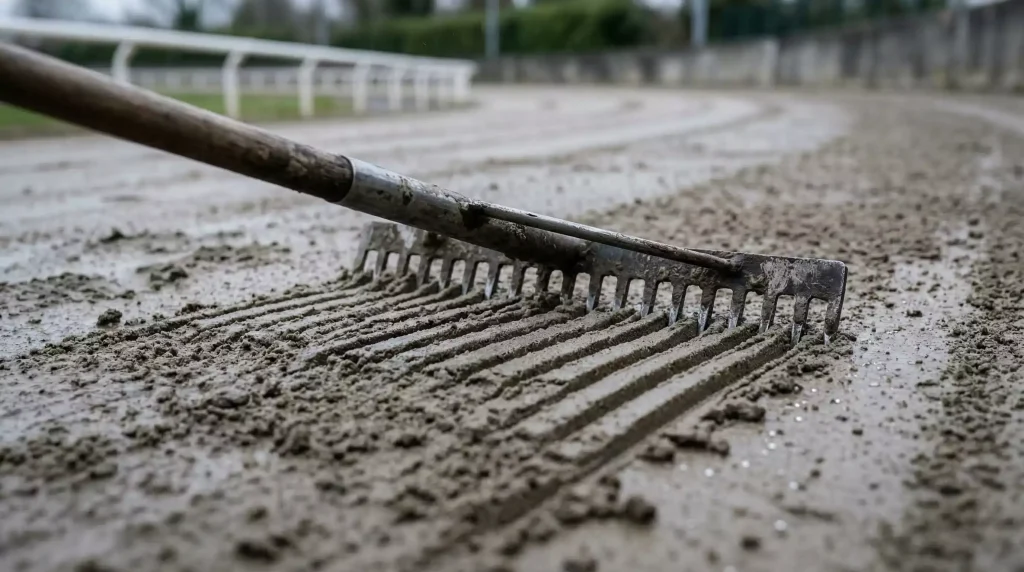
Best Greyhound Betting Sites – Bet on Greyhounds in 2026
Available in USThe Same Dog, the Same Trap — Different Going, Different Result
Going changes everything at Nottingham. The same greyhound, drawn in the same trap, over the same distance, can produce times that differ by half a second or more depending on the state of the track surface. Half a second over 500 metres translates to roughly six lengths — the difference between winning comfortably and finishing in the pack. If you are analysing form at Colwick Park without accounting for the going, you are comparing numbers that do not mean what you think they mean.
Nottingham greyhound going today is reported before each meeting and sometimes updated mid-card, and it is one of the first things an informed bettor checks. Yet it remains one of the most underused pieces of publicly available data. Most punters glance at the going, register it as a single word — fast, normal, slow — and move on. The word tells you something. But the analytical framework behind it tells you far more, and that framework is what this guide explains.
Conditions change everything. That is not a slogan. It is a measurable, demonstrable fact about Colwick Park, and ignoring it costs money.
The wider context is set out in our Nottingham greyhound results hub.
Nottingham’s Surface: Worksop Grey Sand and What It Means
Colwick Park runs on Worksop Grey sand — a specific grade of sand that is standard across several UK greyhound tracks and has particular properties that affect how the surface behaves in different weather conditions. Understanding the surface is the first step toward understanding the going, because the two are inseparable.
Sand tracks, unlike the Boylesports or synthetic surfaces used at some greyhound and horse racing venues, interact directly with moisture. When dry, Worksop Grey sand compacts into a firm, fast surface that returns energy efficiently to the dog’s stride. When wet, it absorbs water and softens, which increases the resistance against each footfall and slows race times. The relationship is not perfectly linear — a light drizzle might have minimal effect, while prolonged rain can transform the surface within an hour — but the direction is consistent: more moisture means slower going.
Nottingham’s 437-metre circuit is exposed to the East Midlands weather pattern, which means it deals with everything from summer dry spells that bake the surface hard to autumn and winter rain that saturates it. The track uses an Outside Swaffham McGee hare system, which runs on the outer rail, and the surface is maintained by a groundskeeping team that waters, grades and rolls the track between meetings. Watering is particularly important: on dry days, controlled irrigation prevents the surface from becoming too hard and potentially unsafe, but it also deliberately alters the going from what natural conditions would produce.
The practical takeaway is that Worksop Grey sand is a responsive surface. It changes with the weather, it changes with maintenance, and it changes across the course of a meeting as six-dog fields churn through it race after race. The inside rail, where traffic is heaviest, can deteriorate faster than the outside, which occasionally shifts the trap bias mid-meeting. If you are only checking the going at the start of the card, you may be operating on outdated information by Race 10.
Going Categories and How They Affect Sectional Times
The going at a UK greyhound track is officially reported using a simple scale: fast, normal and slow, with occasional intermediate descriptions. These categories correspond to measurable differences in race times, and understanding the magnitude of those differences is essential for meaningful form comparison.
On fast going, the surface is dry and firm. Dogs reach their top speed most efficiently — greyhounds are capable of accelerating to around 72 kilometres per hour in a matter of strides, and fast going is where that raw athletic potential converts most directly into race pace. Sectional times to the first bend are at their shortest, finishing times are at their lowest, and the margin for error is smallest. Records tend to fall on fast going because nothing in the surface is working against the dog.
On normal going, the surface carries a moderate level of moisture — either from recent light rain or controlled watering. Times are slightly slower than on fast going, typically by 0.10 to 0.20 seconds over 500 metres, though the exact difference depends on the specific moisture content and how recently the track was prepared. Normal going is the baseline against which most form comparisons are made, because it represents the track’s default state for the majority of the racing calendar.
On slow going, the surface is heavy with moisture. Times increase by 0.20 to 0.40 seconds or more over standard distances, which reshapes the competitive picture considerably. Dogs with a powerful, driving stride — often heavier runners with more muscle mass in the hindquarters — tend to handle slow going better than lighter, speed-oriented types. This is where you see results that contradict what the form suggested, because the going has changed which attributes matter most. A nippy sprint specialist that dominates on fast going may struggle to maintain its usual pace when the surface is pulling at its feet.
Sectional times are affected in a non-uniform way. The first section — from traps to the first bend — tends to be proportionally less affected by going than the later stages of the race. This is because dogs are fresh and their acceleration is less dependent on surface firmness than their ability to sustain pace once the initial burst is spent. By the second and third bends, slow going has a cumulative effect on tired muscles, and the gap between fast-going times and slow-going times widens. This pattern matters: a dog that shows strong early sectionals on slow going is genuinely quick. A dog that shows strong late sectionals on slow going is genuinely fit.
Adjusting Form for Going: Allowances and Calculated Times
Raw race times are only meaningful in context, and the going is the most important piece of that context. If you are comparing a dog’s 29.70 from last Monday on normal going with its 30.05 from this Thursday on slow going, the raw numbers suggest the dog ran 0.35 seconds slower. But after applying a going allowance — the standard adjustment that accounts for surface conditions — the two runs might be virtually identical in terms of actual performance. Without the adjustment, you would conclude the dog is losing form. With it, you would recognise it ran to the same standard on a slower surface.
Going allowances are published by form services and are specific to each track and each meeting. They are calculated by comparing the average times across all races on a given card against the expected times for those races on normal going. If every race on Thursday evening ran 0.25 seconds slower than normal, the allowance for that meeting is approximately +0.25 seconds. You subtract the allowance from each dog’s time to arrive at its “going-adjusted” or “calculated” time — a figure that allows apples-to-apples comparison across different meetings.
The concept is straightforward. The application requires discipline. First, you need to know the going for both meetings you are comparing. Second, you need the allowance for each meeting — which is not always published in the same place as the result. Third, you need to apply the adjustment consistently, which means doing it for every dog you are assessing, not just the ones that fit your pre-existing theory. Cherry-picking adjustments to support a conclusion you have already reached is the fastest way to make the going allowance work against you.
Some form services — Timeform being the most prominent — publish calculated times as standard, sparing you the manual work. If your primary source does not include adjusted times, you can calculate them yourself using the meeting’s going report and the standard allowance scale. The effort is modest. The improvement in form accuracy is significant. Over a season of betting at Nottingham, correctly adjusting for going across the track’s four weekly meetings is probably worth more than any single piece of information you can extract from a racecard.
The bottom line: raw times lie in changing conditions. Adjusted times tell the truth. Every serious form student at Colwick Park should be working with the latter.
The splits it moves are in sectional times.
