
SP vs BSP for Nottingham Greyhounds: Which Price Should You Take?
 Available in US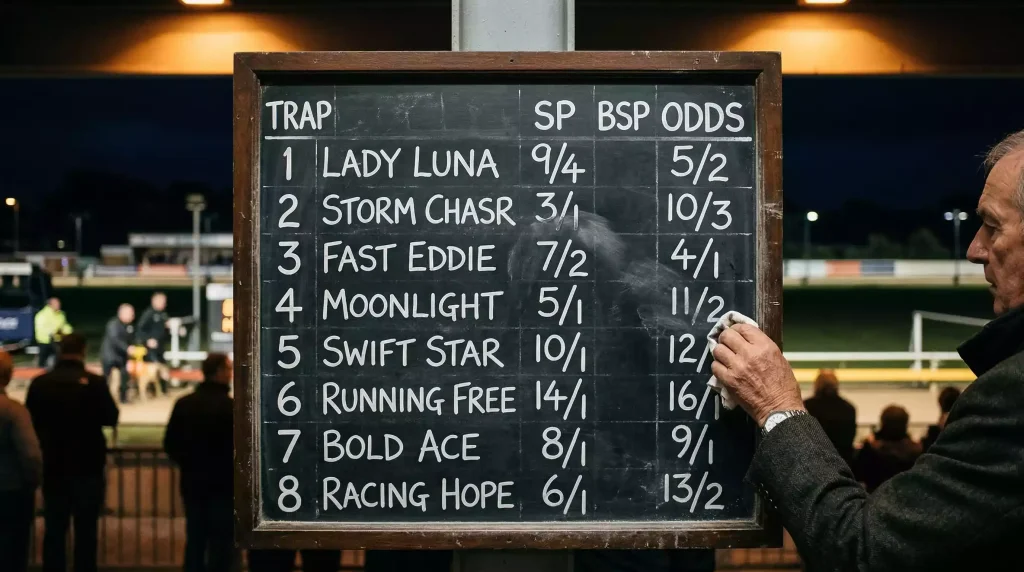
Best Greyhound Betting Sites – Bet on Greyhounds in 2026
Available in USTwo Prices, Two Markets — One Matters More Depending on How You Bet
Every greyhound race at Nottingham produces two distinct prices for each runner: the Starting Price and the Betfair Starting Price. They sound similar. They are calculated by entirely different mechanisms, reflect different market structures and can differ by meaningful margins — margins that, compounded across hundreds of bets, separate profitable punters from those who bleed money without understanding why.
SP is the traditional price, determined by on-course bookmakers at the moment the traps open. BSP is the exchange-derived price, determined by the collective activity of Betfair users. Both are publicly available. Both settle winning bets. But they serve different purposes, reward different betting approaches and behave differently depending on the type of race, the quality of the field and the time of day.
Know which price you are getting. That single piece of awareness is worth more to your long-term return than any individual selection, and this guide explains why.
The wider context is set out in our Nottingham greyhound results hub.
How SP Is Set in Greyhound Racing
The Starting Price is the official price returned by the on-course bookmaker market at the moment the race begins. In practice, the SP for a greyhound race is compiled by an independent SP reporter who surveys the prices offered by the on-course bookmakers — where they exist — and records the most representative price available when the traps open.
The mechanism has a built-in limitation that shapes everything about how SP behaves at greyhound meetings. On-course bookmaker rings at greyhound tracks are thin. At Nottingham, the number of bookmakers standing at any given meeting is far smaller than at a major horse racing fixture, and the volume of money flowing through the on-course market is correspondingly modest. The SP is therefore determined by a relatively small pool of activity, which makes it susceptible to distortion. A single large bet placed on-course moments before the off can shift the SP for the entire market.
That thinness has consequences. Favourites at greyhound meetings tend to return lower SPs than their “true” probability would suggest, because the on-course ring defaults to cautious pricing on the most-backed runners. Outsiders, conversely, can drift to inflated prices because there is insufficient money in the ring to push their odds down. The net effect is an overround — the bookmaker’s margin — that is typically higher in greyhound racing than in horse racing, reflecting the thinner market.
For bettors who rely on SP, the implication is straightforward: you are accepting a price that is determined by a small, imperfect market. UK betting shop turnover on greyhound racing reached £794 million in the 2023-24 period, but the vast majority of that money is bet off-course and does not influence the on-course SP. You are taking a price set by a fraction of the total betting activity, which is not always the most efficient price available.
BSP on Betfair: How Exchange Odds Differ
The Betfair Starting Price operates on a fundamentally different principle. Rather than being set by a handful of on-course bookmakers, BSP is derived from the aggregate activity on the Betfair exchange in the final moments before a race starts. Backers and layers — people betting for and against each outcome — submit their prices, and the BSP is the clearing price at which all remaining matched and unmatched orders are settled.
The exchange model has structural advantages. The market is deeper — more participants, more money, more information. There is no overround in the traditional sense, because Betfair takes a commission on net winnings rather than building a margin into the price. The result is that BSP prices tend to be “truer” than SP in aggregate: they reflect the collective assessment of a larger, more informed pool of bettors.
For greyhound racing specifically, BSP has gained significant traction among serious punters. The total off-course wagering on greyhound racing — encompassing remote, exchange and shop betting — was estimated at approximately £1.5 billion in the 2022-23 period, and exchange betting represents a growing share of that figure. As more money flows through the exchange, the BSP becomes a more reliable indicator of each dog’s actual probability of winning.
However, BSP is not universally superior. On greyhound races with low exchange liquidity — particularly morning meetings at smaller tracks or low-grade races that attract minimal Betfair interest — the BSP can be volatile. A single large order placed or withdrawn in the final seconds before the off can swing the BSP significantly. At Nottingham, where Monday and Friday evening meetings attract decent exchange interest but Wednesday and Thursday morning meetings may not, the reliability of BSP varies by session. Evening meetings, with more bettors active, tend to produce more stable and representative BSPs. Morning meetings are thinner, and the BSP may be less efficient.
The exotic markets are in forecast and tricast betting.
Nottingham Data: Where BSP Beats SP and Vice Versa
The practical question is not which pricing mechanism is theoretically superior. It is which price delivers better returns in specific situations at Colwick Park, and the answer depends on the type of runner and the type of meeting.
For favourites, BSP typically offers marginally better value than SP. Because the on-course ring tends to shorten favourites more than the exchange does, the BSP on a well-backed runner is frequently a tick or two longer than the returned SP. Over a season of betting on favourites, that consistent small edge in price compounds. If you back 200 favourites a year at Nottingham and the BSP averages 5 percent higher than the SP, the cumulative difference in returns is substantial — not because of any individual bet, but because of the repeated marginal advantage.
For outsiders, the picture reverses. The thin on-course ring at greyhound meetings allows outsiders to drift to prices that the exchange would not sustain. A dog might return an SP of 12/1 at Nottingham while the BSP settles at 9/1, because the exchange has attracted enough lay money to cap the price. In this scenario, the SP bettor gets the better deal. If your method leans toward backing longer-priced runners — value selections at 6/1 and above — taking SP or early fixed odds may be more profitable than relying on BSP.
For morning meetings at Nottingham — Wednesday and Thursday — exchange liquidity can be thin enough that the BSP becomes unreliable. A price that looks attractive might have been set by a handful of orders, and the same dog at the same morning meeting a week later might produce a wildly different BSP. In these conditions, taking an early fixed price from a bookmaker, or accepting the SP, gives you more certainty about the value you are getting.
The optimal approach for a regular Nottingham bettor is straightforward in principle: use BSP for favourites on evening cards, where exchange liquidity is deepest and the price advantage is most consistent. Use SP or early fixed odds for outsiders and for morning meetings, where the exchange market is thinner and less efficient. Blend the two approaches based on the specific conditions of each card, and track the results over time to confirm which strategy works for your selection profile. The punters who treat SP and BSP as interchangeable are leaving money on the table. The ones who choose deliberately are not.
