Nottingham vs Other UK Greyhound Tracks: How Colwick Park Compares
 Available in US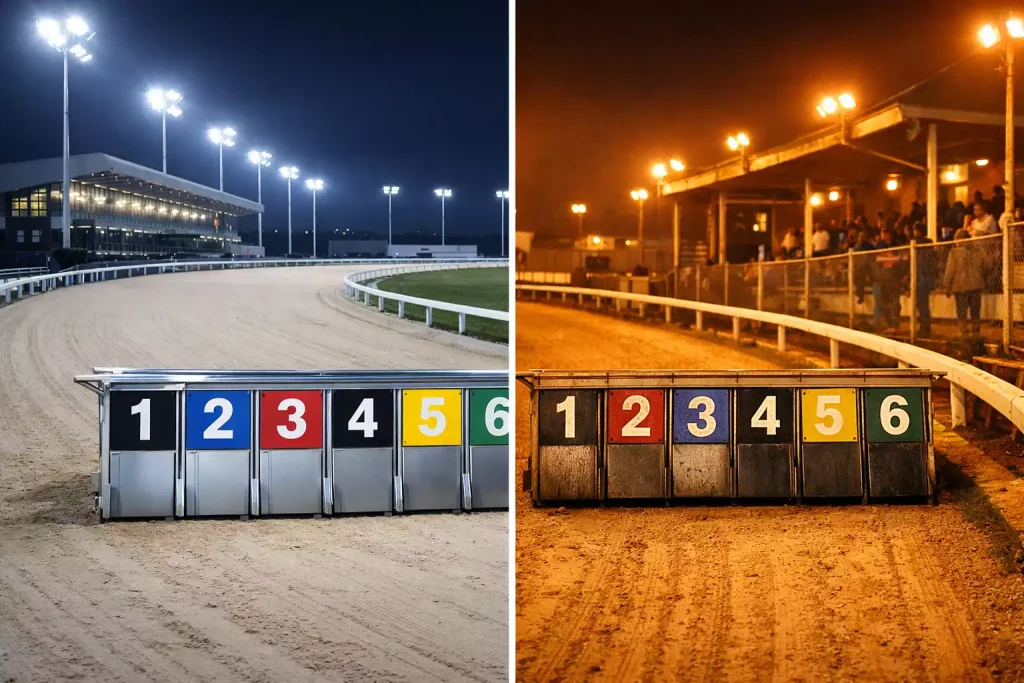
Best Greyhound Betting Sites – Bet on Greyhounds in 2026
Available in USNo Two UK Greyhound Tracks Are Alike
Every greyhound track in the UK has a character shaped by its geometry, surface, lure type and the local training population that feeds it. Nottingham is not Romford. Romford is not Hove. The differences are not cosmetic — they produce measurably different racing outcomes, different trap biases and different form profiles. A dog that dominates at one track may struggle at another, and a bettor who treats all UK venues as interchangeable is ignoring some of the most predictive data available.
Every track has a character. This guide compares Colwick Park’s characteristics with those of other major UK greyhound stadiums, focusing on the dimensions, surfaces and competitive dynamics that matter most for form analysis and betting.
The wider context is set out in our Nottingham greyhound results hub.
Track Dimensions, Surface and Lure Type
Nottingham’s track is a 437-metre circumference running on Worksop Grey sand, with an 85-metre run to the first bend and an Outside Swaffham McGee hare. These are the defining physical parameters, and each one shapes the racing in specific ways. The circumference determines bend tightness — a larger circumference produces wider, faster bends — while the run to the first bend determines how much straight running dogs have before they must negotiate the first turn. Nottingham’s eight race distances, from 305 to 925 metres, give it one of the broadest distance ranges of any UK venue.
Romford, in east London, runs on a tighter circuit — approximately 390 metres — with a shorter run-up to the first bend. That tighter geometry produces sharper bends, which scrubs more speed and amplifies the trap-draw advantage for inside runners. Romford’s distance range is narrower than Nottingham’s, focusing on 225, 400 and 575 metres. The track uses an outside hare like Nottingham, but the combination of tighter bends and shorter distances produces a different racing dynamic: pace and trap position matter even more than at Colwick Park.
Hove, on the south coast near Brighton, has a circumference of approximately 447 metres — slightly larger than Nottingham’s — and a longer run to the first bend. This gives outside-drawn dogs marginally more room to find a clear position before the first turn, which moderates the inside-trap bias that tighter tracks exhibit. Hove’s distances include 285, 500 and 695 metres. The surface is also sand-based, but the coastal climate produces more variable going conditions than Nottingham’s inland location.
Perry Barr in Birmingham, an ARC stablemate of Nottingham, runs on a 408-metre circuit with distances from 264 to 692 metres. As a fellow ARC venue, Perry Barr benefits from the same operational standards and data infrastructure as Colwick Park, which makes cross-venue form comparison between the two tracks slightly more reliable than comparisons involving independently operated venues. The shorter circumference at Perry Barr produces tighter racing than at Nottingham, which influences how dogs trained at one venue perform when they travel to the other.
Crayford in south-east London runs one of the tightest circuits in the UK — around 380 metres — with race distances focused on the 380 and 540-metre trips. The compact layout produces intense, bend-heavy racing that rewards dogs with the ability to corner at speed. A Nottingham dog transferring to Crayford, or vice versa, faces a significant adjustment in track geometry that the raw form figures will not capture.
Trap Bias Across UK Tracks
Trap bias — the extent to which certain trap positions produce a higher win rate than the theoretical average of 16.6 percent — varies from track to track, and the variation is large enough to be analytically significant.
At Hove, data from over 2,800 races shows Trap 1 winning 19.9 percent of the time and Trap 5 winning just 13.6 percent. That gap of 6.3 percentage points represents a substantial structural advantage for inside runners — an advantage that reflects Hove’s specific geometry and the way dogs negotiate its bends.
Nottingham’s trap bias follows a similar pattern but with its own specific numbers. Inside traps at Colwick Park win slightly more often than the theoretical average, consistent with the general principle that a shorter run to the first bend favours dogs that have less ground to cover. At sprint distances — 305 metres, one bend — the bias is most pronounced. At staying distances — 730 metres and beyond — the bias diminishes because the additional bends and longer race allow outside-drawn dogs more opportunities to find a clear run and make up the positional ground lost at the first turn.
The critical point for bettors is that trap bias is not transferable between tracks. A dog that benefits from Trap 1 at Nottingham may not benefit from Trap 1 at Romford, because the two tracks’ geometries create different dynamics at the first bend. The only way to assess trap bias accurately is to use track-specific data, and the form services that publish trap statistics by venue — rather than UK-wide averages — are the ones that give you the most actionable information.
Atmosphere and Visitor Experience
Beyond the data, each track offers a different atmosphere. Romford, located in suburban London, draws a distinctly urban crowd and has a social energy that reflects its proximity to the capital. Hove benefits from the Brighton seafront atmosphere — an evening at the dogs with a coastal backdrop. Perry Barr, as a Midlands rival to Nottingham, offers a similar demographic but with its own local character and a loyal Birmingham-area following.
Nottingham occupies a middle ground: accessible from the city centre without being in it, large enough to accommodate group bookings and corporate events without feeling like a conference centre, and relaxed enough that a first-time visitor in jeans feels as welcome as a regular in the restaurant. The East Midlands location gives it a catchment area that extends into Derbyshire, Lincolnshire and Leicestershire, and the four-meeting-a-week schedule ensures there is always a Colwick Park card within reach for local followers.
The visitor experience at each track is also shaped by its operator. ARC-run venues — Nottingham, Perry Barr, Central Park, Newcastle, Sunderland — share a corporate approach to facilities, hospitality and event management. Independently operated tracks may offer a more idiosyncratic, local-flavour experience. Neither is inherently better. The choice depends on whether you value consistency and polish or character and individuality — and at the best venues, including Colwick Park, you get a measure of both.
Nottingham’s own bias is measured in trap statistics.
