
Nottingham Greyhound Tips: How to Evaluate Selections and Build Your Own
 Available in US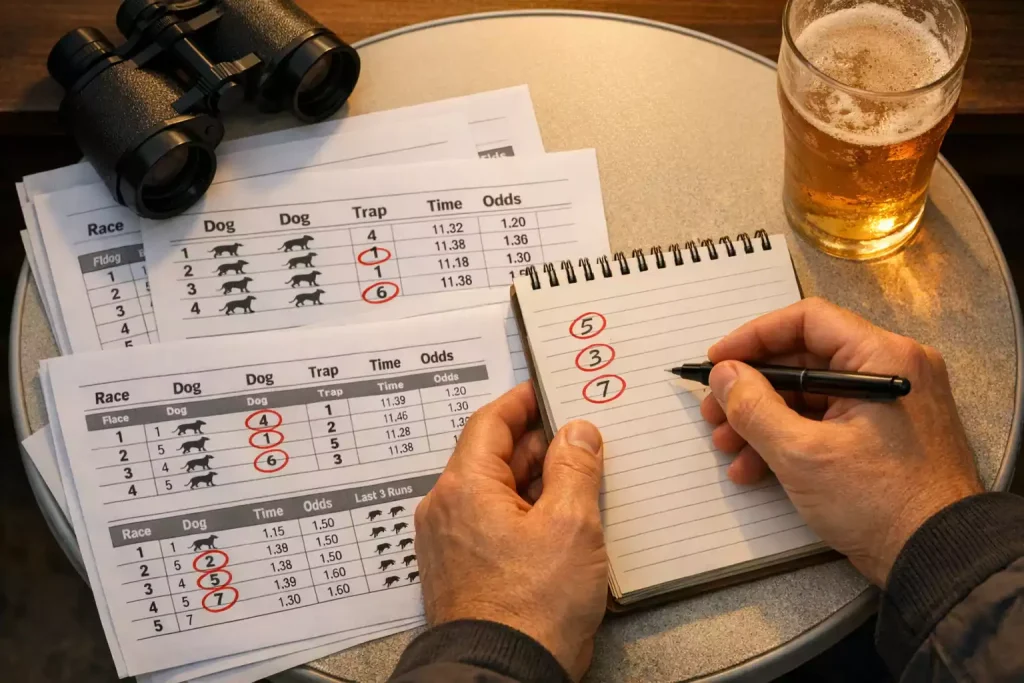
Best Greyhound Betting Sites – Bet on Greyhounds in 2026
Available in USMost Tips Are Noise — Here’s How to Find the Signal
Nottingham greyhound tips today are available from dozens of sources — newspaper columns, social media accounts, dedicated tipping websites, bookmaker blogs and that bloke in the pub who “knows a trainer.” The volume of advice is enormous. The quality, on average, is poor. This is not cynicism. It is arithmetic. If tipping greyhound winners were consistently profitable, the tipsters would be betting rather than publishing, and the market would have adjusted to eliminate the edge they claim to offer.
That does not mean all tips are worthless. Some tipsters apply rigorous form analysis, understand the specific characteristics of individual tracks, and produce selections that outperform random chance over meaningful sample sizes. The problem for the consumer is distinguishing these operators from the noise — the tipsters who publish five selections per card, highlight the winner after the fact, and quietly ignore the four that lost. Think like a tipster, bet like yourself: that means understanding what a credible selection process looks like, recognising the data that should underpin any Nottingham tip, and eventually building a method that is yours rather than someone else’s.
The shift in media rights — described by Adrian Bower of Entain as a “progressive deal” designed to put more investment into the sport — has made more data accessible to more people than at any previous point. That democratisation of information means the raw material for good selections is available to anyone willing to use it. The question is whether you will do the work yourself or outsource it to someone whose incentives may not align with yours.
The wider context is set out in our Nottingham greyhound results hub.
What Good Tipsters Actually Analyse
The best greyhound tipsters, the ones whose records withstand scrutiny over hundreds of selections, tend to share a common methodology. They do not rely on hunches, insider knowledge or a single data point. They build a composite picture of each dog in each race and compare it against the market price. When the market undervalues a runner, they bet. When it does not, they pass.
The core of that composite picture at Nottingham includes several layers. Form figures are the starting point — not just the finishing positions but the context behind them. A dog showing form of 321211 looks strong, but if those wins came at A6 level and it is now racing at A3, the form needs recalibrating. Sectional times add the next layer, revealing whether a dog leads or closes and how its running style interacts with the trap draw. Going adjustments normalise times across different meetings, ensuring a fair comparison between a 29.70 on slow going and a 29.50 on normal.
Across UK greyhound racing, favourites win approximately 30 to 40 percent of races. A good tipster knows this number and uses it as a baseline. If a tipster’s selections win 35 percent of the time at an average price of evens, they are roughly breaking even before factoring in their subscription fee. To generate genuine profit, a tipster needs either a higher strike rate at similar prices, a similar strike rate at higher prices, or a combination of both. Any tip service that does not publish these figures transparently is asking you to trust without evidence.
The best tipsters also understand track-specific nuances. At Nottingham, that means knowing how the 85-metre run to the first bend affects trap bias, how the Worksop Grey sand responds to different weather patterns, and which trainers consistently place their dogs in favourable conditions. These are not secrets — they are available to anyone who studies the data — but the discipline of applying them consistently across four meetings a week is what separates credible tipsters from casual observers who happen to have a social media account.
Building Your Own Nottingham Selection Process
Building your own selection process is not as daunting as it sounds, and it is more rewarding — both intellectually and financially — than following someone else’s tips. The goal is not to become infallible. It is to develop a repeatable method that produces selections with a positive expected value over time.
Start with the trap draw. At Nottingham, Trap 1 wins roughly 18 to 19 percent of races across all distances, compared with the theoretical 16.6 percent that an even distribution would predict. That advantage is structural — inside traps travel a shorter distance to the first bend — and it intensifies at sprint distances. Before looking at any other data point, note which traps have a statistical edge in the race you are studying.
Next, overlay the form and sectional data. For each dog, check its last three to five runs at the relevant distance. Adjust the times for going. Identify the dog’s running style from its first-bend sectional: is it an early-pace runner likely to lead, or a closer that needs the race to unfold a certain way? Then map that running style against the trap draw. An early-pace dog drawn inside at 305 metres is a powerful combination. A closer drawn inside in a field full of fast breakers may struggle to get a clear run.
Add a grade filter. A dog dropping from a higher grade is potentially well-in — it has more ability than its new rivals. A dog rising after a big win faces stiffer competition and may find the step up too sharp. Grade changes are published on every racecard and are one of the most underused data points in greyhound form study.
Finally, compare your assessment to the market price. If your analysis says a dog has a 25 percent chance of winning and the bookmaker offers 5/1 (a 16.7 percent implied probability), you have found value. If the bookmaker offers 2/1 (a 33 percent implied probability), the market has already priced in what you see. Value betting — not winner-finding — is what makes a selection process profitable over time. This distinction is the most important lesson in the entire guide, and it is the one that most casual tipsters never grasp.
The draw is the first factor to weigh: trap statistics.
Evaluating Tipster Track Records
If you choose to follow a tipster rather than build your own selections, evaluation is everything. A tipster without a verified, transparent track record is not a tipster — they are a content creator with opinions. The distinction matters because your money is at stake.
The first metric to demand is sample size. A tipster who shows 12 winners from 20 selections looks impressive until you realise that 20 bets is statistically meaningless. Variance alone can produce a 60 percent strike rate over 20 bets from a random selection process. You need at least 200 to 300 tracked selections before the numbers start to tell you something reliable about the tipster’s skill. Any service that launched last month and is already claiming market-beating performance should be treated with extreme scepticism.
The second metric is profit to advised odds. A tipster might highlight a winner at 8/1, but if you could only get 5/1 by the time the tip was published and the price had moved, the 8/1 figure is meaningless to you. Good tipsters publish their selections early enough for subscribers to obtain the advised price, or they use SP/BSP as the benchmark so there is no ambiguity about what was actually achievable.
The third metric is level-stakes profit. The cleanest way to evaluate any tipster is to assume a level stake on every selection and measure the cumulative profit or loss. This strips out staking plans — some of which are designed to disguise a losing selection record by increasing stakes on higher-confidence picks and reducing them on speculative ones. Level-stakes profit is honest. If it is positive over 500 or more selections, the tipster has an edge. If it is not, they do not, regardless of how they frame it.
The uncomfortable truth is that very few greyhound tipsters produce sustained level-stakes profit when measured rigorously. That is not a criticism of the tipsters — it reflects the efficiency of the greyhound betting market, which prices up six-dog fields with reasonable accuracy most of the time. The edge, when it exists, is thin. Which is exactly why building your own process — where you control the method, the stakes and the discipline — is usually the better investment of time and money.
