
Greyhound Speed and Physiology: Why These Dogs Are Built to Race
 Available in US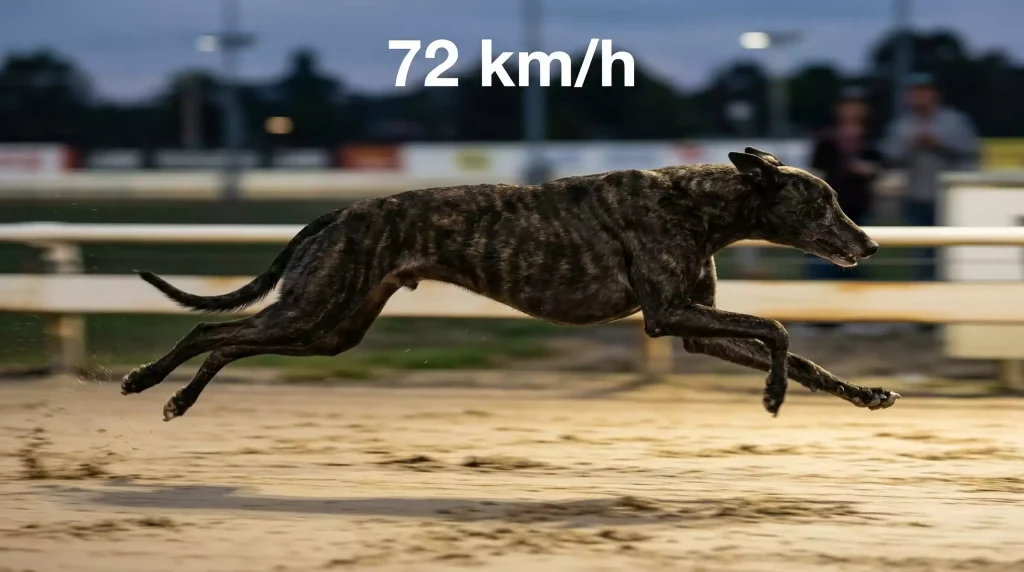
Best Greyhound Betting Sites – Bet on Greyhounds in 2026
Available in USA Greyhound Reaches 72 km/h in Six Strides
A greyhound can accelerate to approximately 72 kilometres per hour — around 45 miles per hour — within roughly six strides from a standing start. That makes the greyhound the fastest dog breed on the planet and one of the fastest accelerating animals of any species over short distances. Typical race speeds at Nottingham and other UK tracks settle to around 58 to 61 kilometres per hour once the initial burst is spent, but it is the acceleration phase that shapes the opening seconds of every race and often determines the result.
Understanding greyhound speed and physiology is not an academic exercise for the bettor or fan. It is the foundation on which every piece of form analysis rests. Why does trap draw matter so much at 305 metres? Because the explosive acceleration means positions are established in the first few strides, and the geometry of the first bend locks them in. Why do hind limb injuries dominate the veterinary data? Because the muscles that generate that acceleration are the most heavily stressed in the body. Built for the bend, engineered by evolution for speed — the greyhound is a biological racing machine, and knowing how that machine works makes you better at reading what it does on the track.
What that speed produces is in the track records.
Speed, Stride and the Double Suspension Gallop
The greyhound’s running gait is called the double suspension gallop, and it is the biomechanical foundation of the breed’s speed. In this gait, the dog is airborne twice during each stride cycle — once with all four legs gathered under the body, and once with all four legs extended. This produces a stride length that is extraordinary relative to body size: a racing greyhound in full flight covers roughly five metres with each stride.
The double suspension gallop is not unique to greyhounds — cheetahs use the same gait — but the greyhound’s version is optimised for sustained speed rather than pure burst acceleration. A cheetah can outpace a greyhound in the first 100 metres but fatigues rapidly. A greyhound maintains near-peak speed over distances that would exhaust most other animals. Over 500 metres at Nottingham, a greyhound completes the course in approximately 29 to 31 seconds, maintaining an average speed of around 60 kilometres per hour throughout. The ability to sustain that speed — not just to achieve it — is what separates winners from the rest of the field.
Stride frequency and stride length interact to produce overall speed. A greyhound with a slightly shorter stride but a faster leg turnover may produce the same top speed as one with a longer stride and slower turnover. These differences in running style are visible to experienced observers watching replays and are reflected in the sectional times that form services publish. A dog that covers the ground with long, sweeping strides tends to be a front-runner that sustains a high cruising speed. One with quicker, more compact strides may be a closer that accelerates more efficiently out of traffic and through gaps. At Nottingham, where the 85-metre run to the first bend rewards early acceleration, stride mechanics directly influence which dogs secure the best racing positions from the traps.
Anatomy for Racing: Muscles, Lungs and Heart
The greyhound’s body is a catalogue of evolutionary adaptations for speed. Every major system — musculoskeletal, cardiovascular, respiratory — is configured to support high-intensity sprint performance.
The muscular system is dominated by fast-twitch fibres, which produce rapid, powerful contractions at the expense of endurance. The hindquarters are the primary engine, with the gracilis, semitendinosus and biceps femoris muscles generating the propulsive force that drives the dog forward. These are also the muscles most vulnerable to injury: GBGB’s 2026 data recorded 1,013 hind limb muscle injuries from 355,682 runs, making this category the most common injury type in licensed racing. The very muscles that make greyhounds fast are the ones that break first under stress.
The cardiovascular system is oversized relative to body mass. A racing greyhound’s heart is proportionally larger than that of most other dog breeds, pumping a greater volume of oxygenated blood to the working muscles during exercise. The resting heart rate of a greyhound is notably lower than that of comparably sized dogs — a reflection of cardiac efficiency — and the heart rate during a race can exceed 300 beats per minute. That cardiovascular capacity is what allows the dog to sustain sprint-level effort for the 29 to 60 seconds that a race demands.
The respiratory system is similarly optimised. Greyhounds have a larger lung capacity relative to body size than most breeds, and their nasal passages are wider, allowing for greater airflow during the intense breathing that high-speed running requires. The combination of large lungs, an efficient heart and a high proportion of oxygen-carrying red blood cells creates an aerobic system that can support anaerobic effort for longer than the competition.
How Physiology Translates to Track Performance
For the bettor and form student, physiology is not an abstract concept — it manifests in the data you see on every racecard. The dog’s weight, its recent times, its sectional splits and its running style are all expressions of underlying physical attributes that the greyhound’s body determines.
A heavier dog — 33 kilograms versus 28 kilograms — carries more muscle mass, which generally translates to greater power output. But that power comes at a cost in acceleration: heavier dogs tend to be slower out of the traps and faster in the later stages of a race, which is why weight correlates loosely with staying ability. The sprint specialists at 305 metres tend to be lighter, leaner dogs with maximum fast-twitch fibre. The marathon runners at 925 metres tend to be heavier, with a greater proportion of slow-twitch endurance fibre.
The going interacts with physiology in measurable ways. On slow going, the surface absorbs more of the energy that the hind limb muscles produce, which means heavier, more powerful dogs handle soft conditions better than lighter, speed-oriented ones. Conversely, on fast going, the lighter dog’s superior acceleration is rewarded because the surface returns energy efficiently. This is why the going at Colwick Park changes not just the times but the type of dog that wins.
Understanding physiology also illuminates the injury data. The reason hind limb muscles are the most commonly injured body part is not random — it is a direct consequence of where the greatest physical stress concentrates during racing. The reason wrist injuries are more common on tight tracks is that the inside front leg bears extreme loading through bends. The anatomy determines the vulnerability, and the vulnerability shapes the form. Built for the bend, but not indestructible — and the form student who understands that distinction reads the racecard with an advantage that pure data analysis alone does not provide.
The wider context is set out in our Nottingham greyhound results hub.
