
Greyhound Sectional Times at Nottingham: What Split Data Really Tells You
 Available in US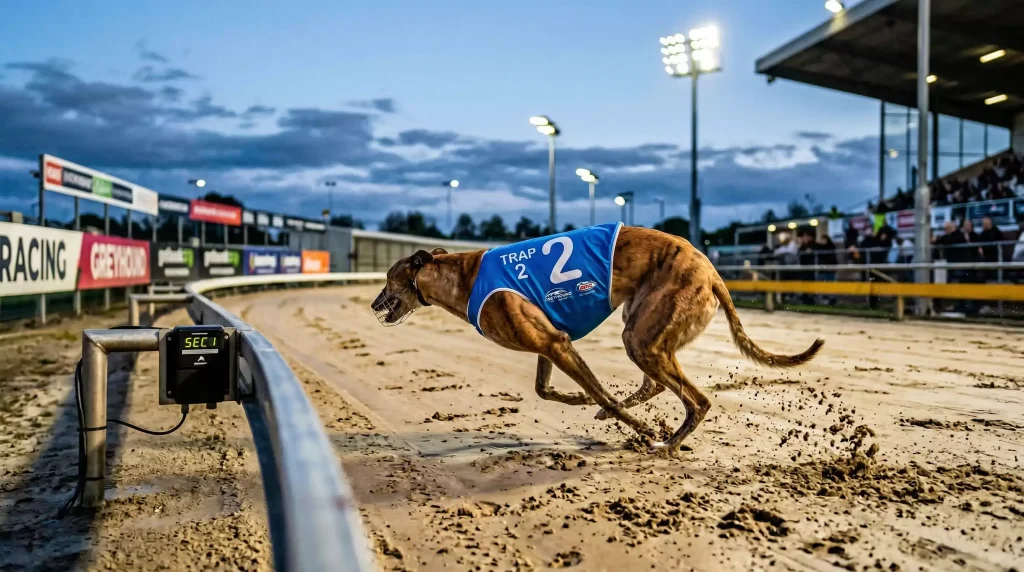
Best Greyhound Betting Sites – Bet on Greyhounds in 2026
Available in USFinishing Time Alone Doesn’t Tell the Full Story
Greyhound sectional times at Nottingham reveal what a finishing time alone cannot: how a race was run, not just how fast it ended. Two dogs can cross the line in identical times and have run completely different races — one leading from the traps and holding on, the other trailing the field before producing a devastating closing burst. The finishing time treats them as equals. The sectional times tell you they are fundamentally different types of runner, and that distinction shapes everything from trap-draw analysis to race prediction.
Colwick Park’s layout makes sectional data particularly informative. The 85-metre run to the first bend on a 437-metre circumference means the early section of any race at Nottingham is short and decisive. A fast sectional to the first bend identifies a dog with genuine early pace — the kind of runner that can secure a clear position before the field compresses into the turn. A slower sectional to the same point identifies a dog that relies on what happens after the first bend, which introduces more variables and more risk.
The seconds that separate winners from the rest of the field at Nottingham are often hidden in the sectional data rather than in the headline finishing time. This guide explains what sectional times measure, how they differ from calculated times, and how to use both when building a picture of a race before it happens.
The wider context is set out in our Nottingham greyhound results hub.
What Sectional Times Measure at Nottingham
A sectional time is the elapsed time for a specific segment of a race, rather than the race as a whole. At most UK greyhound tracks, including Nottingham, the primary sectional is the time from the traps to the first bend — a distance of 85 metres at Colwick Park. This first-bend sectional is the most widely published and the most analytically useful, because it captures the phase of the race where trap position, break speed and early pace interact most directly.
The first-bend sectional at Nottingham typically falls in the range of 4.80 to 5.30 seconds for a standard 480- or 500-metre race, depending on the grade and the going. An early-pace runner — a dog that leaves the traps fast and drives hard to the bend — will post a sectional at the lower end of that range. A closer — a dog that settles in the first section and accelerates later — will post a slower sectional but may produce a comparable or faster finishing time if it gains ground through the second half of the race.
Some form services also publish a second sectional, covering the middle portion of the race between the first and second bends, and occasionally a closing sectional that measures the final run to the line. These finer-grained splits are less consistently available but are valuable when they exist, because they break the race into three distinct phases: initial speed, sustained pace and finishing effort. A dog that is fast in the first sectional but slow in the closing sectional is a frontrunner that tires. A dog that is moderate in the first sectional but fast in the closing sectional is a finisher. Both might record the same total time; the composition of that time determines how each dog will perform against different types of opposition.
At Nottingham specifically, the short run to the first bend amplifies the importance of the first-bend sectional. On a track with a 120-metre run-up, a slow break costs less because there is more room to recover before the bend. At Colwick Park, with only 85 metres of straight, a slow break translates directly into a poor position at the first bend — and from there, the dog must navigate traffic, cover extra ground on the outside or wait for a gap that may never materialise. The first-bend sectional is not just a number at Nottingham. It is a proxy for how much trouble a dog is likely to encounter in the race.
Calculated Times vs Raw Times: A Key Distinction
Raw times are what the clock shows. Calculated times are what the clock would have shown if external variables — going, crowding, interference — had not affected the run. This distinction is the single most important concept in greyhound form analysis, and it is the one that most casual punters ignore entirely.
A raw finishing time of 29.80 over 500 metres at Nottingham is a fact. A calculated time of 29.45 for the same run is an interpretation — one that says the dog was capable of running 0.35 seconds faster had the going been normal rather than slow, or had the dog not been checked on the second bend. Calculated times are produced by form services such as Timeform, which apply algorithmic adjustments based on the going report, the race comments and the known characteristics of each dog’s running style.
The value of calculated times is most apparent when comparing form across different meetings. Consider the Nottingham 500-metre track record of 29.05 seconds, set by Skywalker Logan during the 2019 Derby. That time was recorded on fast going in an elite open race. If a dog runs 29.40 on normal going in an A2 race, its raw time is 0.35 seconds outside the record. But its calculated time, adjusted for going, might be closer to 29.20 — a performance that is genuinely impressive in context, even though the raw number does not look like it.
The danger of calculated times is over-reliance. They are estimates, not measurements. The going allowance used to adjust a time is an average applied across an entire meeting, and it may not perfectly represent the conditions that a specific dog experienced in a specific race. The inside rail may have been heavier than the outside. Watering between races may have changed the surface after the allowance was set. A dog that experienced interference loses time in a way that even a calculated adjustment cannot fully recover, because the adjustment estimates how much time was lost — it does not replay the race.
The practical approach is to use both figures. Raw times tell you what happened. Calculated times tell you what was likely possible. When the two diverge significantly, that gap is where the form story lives — and it is usually the story that the racecard alone does not tell.
The trips they are measured over are in stadium distances.
Using Sectional Data to Predict Race Outcomes
Sectional data moves from interesting to actionable when you use it to map how a race is likely to unfold before the traps open. The method is not complicated, but it requires discipline and a willingness to think about a race as a sequence of phases rather than a single event.
Start by identifying the early-pace runners. Look at each dog’s first-bend sectional across its last three to five runs. Dogs that consistently post fast sectionals — below 4.90 seconds at Nottingham over 500 metres — are frontrunners. They want to lead through the first bend and control the race from the front. If two or more dogs in the same race share that profile and are drawn in adjacent traps, there is a high probability of crowding at the first bend. Both may lose their usual positional advantage, which opens the door for a mid-pack runner with a slower sectional but a cleaner run.
Next, identify the closers. Dogs with slower first-bend sectionals but fast finishing times are closing types. They sit behind the pace early and accelerate in the second half of the race. At Nottingham, closers face a specific risk: the tight bends and short straights mean there are fewer opportunities to pass tiring leaders. A closer needs racing room, and at Colwick Park, room is a limited commodity. A closer drawn in Trap 6 on a 480-metre race may find a wider route and make up ground. The same closer drawn in Trap 3 may spend the entire race trapped behind slower dogs with no way through.
The predictive power of sectional data comes from combining running-style profiles with the trap draw. If the fastest early-pace dog is drawn in Trap 1 and no other runner in the field has a comparable first-bend sectional, that dog is likely to lead unchallenged through the first bend — a huge advantage at Nottingham. If the fastest closer is drawn in Trap 5 with a clear outside run and the early-pace dogs are packed into Traps 1 through 3, the closer has a realistic route to victory even without leading early.
Greyhound racing in the UK is approaching its centenary in 2026, and as Sir Philip Davies, GBGB Chairman, noted, it is a moment to “celebrate our centenary” — a hundred years during which the analytical tools available to followers of the sport have evolved enormously. Sectional times are one of the most powerful tools in that toolkit. They do not guarantee winners, but they consistently improve the quality of your selections, and at a track like Nottingham — where the geometry punishes the uninformed — that improvement compounds over time.
