Nottingham Greyhound Racecards Explained: Every Column, Symbol and Abbreviation
 Available in US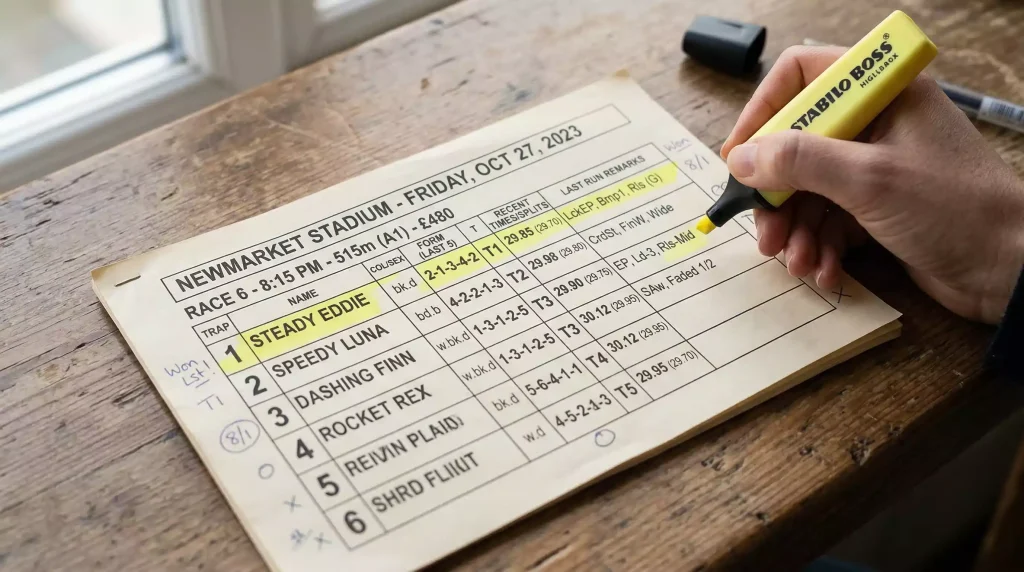
Best Greyhound Betting Sites – Bet on Greyhounds in 2026
Available in USThe Racecard Is Your Pre-Race Intelligence Report
Nottingham greyhound racecards contain more pre-race information per square centimetre than almost any other document in sport. The problem is that most of it is encoded in abbreviations, single-digit numbers and typographical shorthand that was designed for printers in the 1950s and never meaningfully updated for the digital era. If you cannot read a racecard fluently, you are making selections based on trap colour and name recognition — which is roughly equivalent to picking stocks by ticker symbol.
Every column on a Nottingham racecard corresponds to a specific piece of information about the dog, its recent history, its trainer and its expected performance at Colwick Park. Some of these columns are self-explanatory. Others require context. A handful require genuine expertise to interpret, and those are the ones that separate form students from casual viewers. As Mark Bird, CEO of the Greyhound Board of Great Britain, has noted, the welfare and data initiatives now embedded across the sport mean that the quality and transparency of information available to the public has never been higher. That investment in data infrastructure benefits anyone willing to learn how to use it.
This guide breaks down every column, symbol and abbreviation you will encounter on a Nottingham racecard, so that the next time you open one, every character means something.
The wider context is set out in our Nottingham greyhound results hub.
Column-by-Column Breakdown
The trap number is the leftmost column, and it tells you which starting box the dog will break from. Nottingham uses a standard six-trap formation. Trap numbers are colour-coded on printed cards and on-screen: 1 red, 2 blue, 3 white, 4 black, 5 orange, 6 striped black and white. The trap assignment is not random — it is allocated by the racing manager based on each dog’s running style, although in graded races, the draw is largely determined by form and previous trap performance.
The dog’s name follows, and underneath or beside it you will usually see the trainer’s name and the owner’s name. Trainer information is more useful than it appears. Certain Nottingham trainers specialise in sprint dogs, others in stayers. Some have a notably better record with dogs drawn in specific traps. Over time, learning the tendencies of the local training population gives you a qualitative layer that pure numbers miss.
The form figures are a sequence of digits — typically the last six results — read from left to right with the most recent run on the right. A “1” means the dog won, a “2” means second place, and so on. A “0” indicates a finish outside the top six. Letters sometimes replace numbers: “F” for fell, “T” for brought down by a faller, and occasionally “D” for disqualified. Form figures are a compressed narrative. A sequence like 321211 reads very differently from 665540, and both of those read differently again if you know the grades in which those results were achieved.
The best time column shows the fastest recorded time for the dog at the race distance, either at Nottingham or across UK tracks. At Colwick Park, where eight distances are in play — from the 305-metre sprint to the 925-metre marathon — the best time needs to be read in context. A dog showing a best of 29.40 over 500 metres is operating at near-track-record pace. That same dog’s best at 305 metres tells you nothing about its stamina over 680 metres. Always check which distance the best time refers to.
The grade column indicates the class of the race. Nottingham uses the standard GBGB grading system, which ranges from A1 at the top of the graded ladder down through A2, A3 and beyond, plus open races and special categories. A dog running in an A3 race that previously competed in A1 has been downgraded, which might mean it is declining — or that it is a class above the current opposition and likely to dominate. Grade context is essential.
The weight column records the dog’s racing weight in kilograms. Weight fluctuations between races can be a signal. A dog that has gained a kilogram since its last run may have been rested and is returning fresh. A dog that has lost weight could be overraced. Small changes — 0.2 to 0.3 kilograms — are generally insignificant. Shifts of a kilogram or more deserve attention.
The sectional time or calculated time, where shown, indicates the dog’s split time to a specific point on the track, usually the first bend. On Nottingham’s 437-metre circumference, with a run of 85 metres to the first bend, this figure reveals early pace. Two dogs might both have a best time of 29.60 over 500 metres, but if one reaches the first bend in 4.90 seconds and the other in 5.10 seconds, they run very different races. The faster sectional runner leads early and tries to control the race from the front. The slower sectional runner relies on closing speed, which means navigating traffic in the back half of the race — a riskier proposition.
The comments column, where included, contains abbreviated race comments from the dog’s most recent runs. These might note running position (“led first bend”), track conditions (“slow away”), interference (“checked bend 2”) or other context that the numbers alone cannot capture.
Putting the card to work is the form guide.
Symbols and Shorthand: W, m, bk, nk and More
Greyhound racecards use a compact shorthand that originated when space on printed cards was genuinely expensive. The abbreviations remain largely unchanged, and knowing them is non-negotiable if you want to read form efficiently.
Distance abbreviations describe the margins between runners at the finish. “SH” is a short head — the smallest possible winning distance, perhaps a few centimetres. “Hd” is a head, slightly more. “Nk” is a neck, roughly half a length. From there, distances are expressed numerically: 1 (one length), 1½ (one and a half lengths), 2, 3 and so on. A length in greyhound racing is approximately 0.08 seconds in timing terms, though this varies with the pace of the race. When you see a result showing the winner beating the second dog by 4 lengths, you are looking at a margin of about 0.32 seconds — decisive in greyhound terms.
“W” in a form line indicates the dog won that race. It is sometimes used in place of the position number “1” on certain platforms. “m” denotes a middle runner — a dog that tends to race along the middle of the track rather than hugging the rail or swinging wide. “bk” means the dog was bumped or knocked during the race, usually at a bend. “crd” stands for crowded — the dog was squeezed for room, which may have cost it positions without any single incident being to blame.
“SAw” means slow away — the dog was slow to leave the trap, losing ground at the start. On a tight track like Nottingham, where the first bend comes up quickly, a slow break at 305 metres can be the entire race. “Ld” or “led” means the dog led at some point during the race. “RnUp” means the dog challenged the leader — ran up to their shoulder — without getting past. “EP” stands for early pace: the dog showed speed in the first section of the race.
There is no universal standard across all platforms for every abbreviation, and Nottingham racecards accessed through different providers may use slightly different shorthand for the same thing. The core set listed here covers the majority of what you will encounter. If a symbol appears that you do not recognise, the safest approach is to check the platform’s own glossary — most form services provide one, usually buried three clicks deep in the navigation.
Nottingham-Specific Racecard Features
While the basic structure of a greyhound racecard is standardised across all GBGB-licensed tracks, Nottingham has a few characteristics that affect how you read and interpret its cards.
First, the range of distances. Colwick Park offers eight race distances: 305, 480, 500, 680, 730, 885, 905 and 925 metres. That is one of the broadest distance ranges of any UK track. It means a Nottingham racecard can feature a pure sprint followed immediately by a staying marathon, and the form profiles of the dogs in those two races are completely different. A racecard for a track that only runs three or four distances is more internally consistent. At Nottingham, you need to mentally reset your expectations between races more frequently.
Second, the hare type. Nottingham uses an Outside Swaffham McGee, meaning the lure runs on the outside of the track. This affects running lines, particularly on bends, and is worth noting when you see racecard comments about dogs “running on” or “hanging.” A dog described as “wide runner” at Nottingham may behave differently at a track using an inside hare.
Third, the PGR branding. Since January 2026, Nottingham racecards distributed through Premier Greyhound Racing — the media brand that now represents 14 UK greyhound tracks — carry a standardised format that makes cross-track comparison slightly easier than it used to be. PGR-format cards tend to include more detailed sectional data and more consistent abbreviation conventions. If you are pulling your Nottingham racecard from a PGR-affiliated source, the data you see is likely to be more complete than a generic bookmaker racecard.
Understanding these specifics turns the racecard from a page of data into a document you can actually read. And reading it properly, rather than scanning it for a name you half-recognise, is the first step toward making selections that are grounded in evidence rather than instinct.
