Arena Racing Company and Greyhound Racing: How ARC Runs Nottingham and Beyond
 Available in US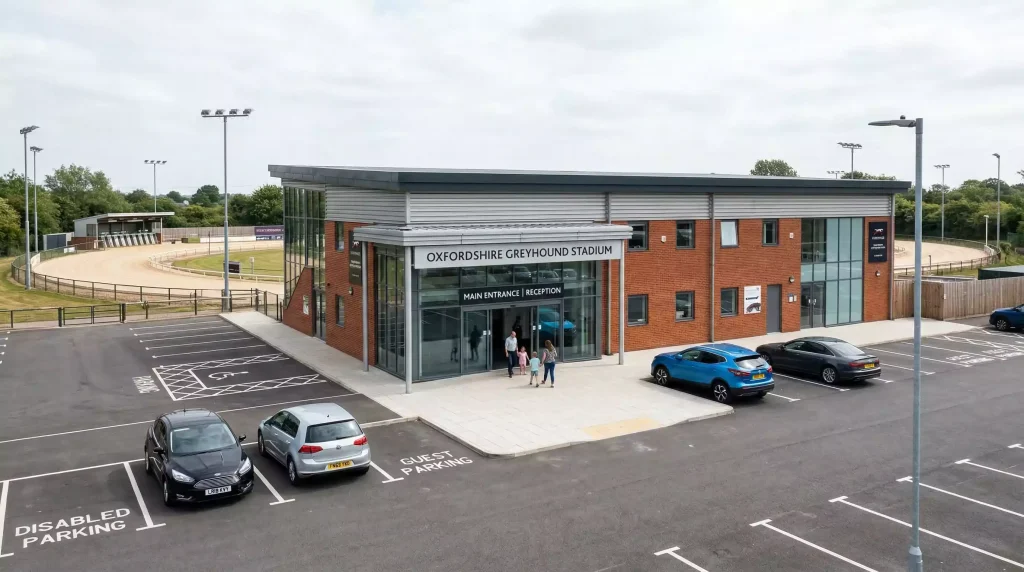
Best Greyhound Betting Sites – Bet on Greyhounds in 2026
Available in USARC Operates Five of the UK’s Premier Greyhound Venues
Arena Racing Company is the largest racecourse operator in the UK, and its greyhound division has quietly become one of the most influential forces in British greyhound racing. ARC operates five greyhound stadiums directly — Central Park in Swindon, Nottingham, Perry Barr in Birmingham, Newcastle and Sunderland — and through Premier Greyhound Racing it now represents a network of 14 UK tracks. The operator behind the track matters because it determines the investment in facilities, the quality of the racing programme, the media coverage and, ultimately, the data that reaches the bettor’s screen.
For most punters, ARC is invisible. The brand on the stadium is “Nottingham Greyhounds,” not “Arena Racing Company.” But the decisions made at ARC’s corporate level — which events to schedule, which media deals to sign, how much to invest in track maintenance — shape every card at Colwick Park. Understanding who runs the track, and how they run it, adds a layer of context that pure form analysis cannot provide. The operator behind the track is, in a real sense, the operator behind the product you are betting on.
The wider context is set out in our Nottingham greyhound results hub.
ARC’s Greyhound Portfolio: Five Tracks, One Strategy
ARC’s five greyhound venues are spread across England, each serving a different regional market but operating under a unified strategic framework. Central Park handles the south-west. Nottingham covers the East Midlands. Perry Barr serves the West Midlands, one of the strongest traditional markets for greyhound racing in the country. Newcastle and Sunderland cover the north-east. Together, the five tracks provide national geographic coverage and a combined racing output that contributes significantly to the total volume of UK greyhound racing.
The unified strategy is visible in how the tracks are scheduled, maintained and marketed. ARC coordinates its greyhound venues to avoid direct scheduling clashes, spreading meetings across the week so that the portfolio offers racing on most days and most sessions — morning and evening. From January 2026, this coordination extends beyond ARC’s own five tracks to the broader Premier Greyhound Racing network of 14 venues, creating a near-continuous national product that bookmakers and broadcasters can programme around.
At the individual track level, ARC’s ownership brings standardised operational practices: consistent safety protocols, shared groundskeeping expertise, centralised veterinary standards and a single management structure overseen by a dedicated Greyhound Operations Director. These may not be visible to a punter watching from home, but they manifest in the quality of the track surface, the consistency of the going reports and the reliability of the data feeds. A bettor analysing form at Nottingham can be confident that the operational standards match those at Perry Barr or Central Park, because the same organisation sets the rules for all five venues.
The portfolio approach also gives ARC negotiating leverage that an independent operator cannot match. When ARC negotiates media rights, data licensing agreements or sponsorship deals, it does so on behalf of five tracks simultaneously — and through PGR, on behalf of fourteen. That scale translates into better terms, which in turn funds the investment in facilities and prize money that keeps the racing product competitive. An independent Nottingham, operating alone, would struggle to secure the broadcasting reach that ARC delivers as part of a portfolio. Within the ARC structure, Colwick Park benefits from a collective bargaining position that would have been unimaginable when the stadium opened in 1980 under independent ownership.
The Entain Media Deal and What It Changed
The most consequential decision ARC has made for its greyhound portfolio was the long-term media rights agreement signed with Entain in 2021, which took effect in January 2026. Entain — the parent company of Ladbrokes, Coral and several international betting brands — secured exclusive media rights to ARC’s greyhound content, including live pictures, data feeds and the right to distribute that content across its retail and digital network.
When the deal was announced, Kevin Robertson of ARC described it as a “new era of collaboration” between track operators and the betting industry. The significance of that description was not rhetorical. The Entain deal restructured how revenue flows from greyhound betting to the venues that produce the racing. Under the previous model, tracks relied on a patchwork of individual bookmaker agreements and the voluntary BGRF levy. Under the Entain deal, ARC receives a guaranteed media rights fee that provides a stable, predictable revenue stream — more akin to how Premier League football clubs are funded by broadcast rights than how greyhound tracks have traditionally operated.
For Nottingham specifically, the Entain deal meant that every race at Colwick Park is now broadcast to a network of several thousand betting shops and millions of digital users. The racing product that was once primarily consumed by on-course spectators now reaches an audience that dwarfs the stadium’s 1,500-person capacity by orders of magnitude. The track’s commercial value is no longer defined by how many people walk through the gate. It is defined by how many screens carry the picture.
The deal also accelerated the creation of Premier Greyhound Racing as a media brand. PGR provides a unified presentation layer for the 14 tracks it represents, with standardised graphics, data formats and scheduling. For bettors, this standardisation is a practical improvement: the racecard, result and data format from Nottingham now matches the format from every other PGR track, making cross-venue form comparison cleaner than it was under the fragmented system that preceded it.
Its broadcast arm is explained in Premier Greyhound Racing.
How ARC’s Operations Affect Racegoers and Bettors
For on-course visitors to Nottingham, ARC’s ownership manifests most visibly in the stadium facilities. Investment in the restaurant, bars, viewing areas and parking — Colwick Park offers space for 1,000 vehicles — reflects a corporate approach to venue management. Evening meetings, particularly on Mondays and Fridays, are marketed as entertainment experiences rather than pure racing events, with hospitality packages aimed at corporate groups and social outings as well as dedicated racing fans.
For remote bettors, ARC’s impact is felt through data quality and broadcast reliability. The live feeds from Nottingham are produced to a consistent standard, the result data reaches bookmaker platforms quickly and the form information is comprehensive. These may seem like baseline expectations, but in an industry where independent tracks have historically varied widely in their data provision, the ARC standard represents a measurable improvement. If you study form across multiple tracks, the consistency of the ARC and PGR data pipeline means you spend less time cleaning data and more time analysing it.
The broader effect of ARC’s consolidation strategy is harder to quantify but no less real. By operating five tracks under one roof and coordinating fourteen through PGR, ARC has created a national greyhound product that is more commercially viable than a collection of independent tracks could sustain. The trade-off is that individual venue identity can be diluted by the corporate structure — a criticism that some traditionalists level at the consolidation model. Whether that trade-off is worthwhile depends on your perspective. For the venues themselves, including Nottingham, ARC’s ownership has provided the financial stability and media infrastructure that keeps the traps opening four times a week. In an era when dozens of UK greyhound stadiums have closed, that stability is not a trivial achievement.
