The History of Nottingham Greyhound Stadium: From 1980 to the ARC Era
 Available in US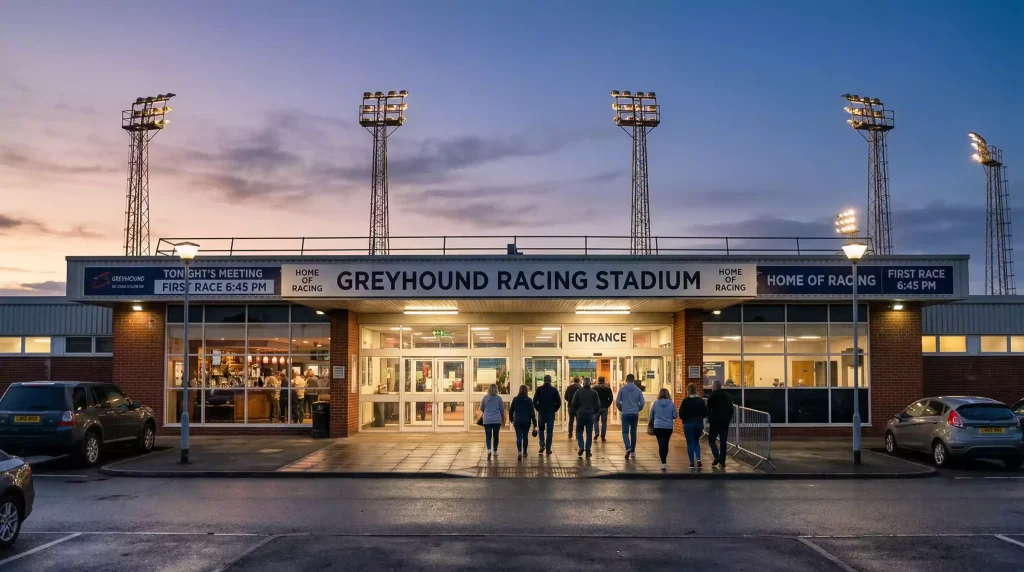
Best Greyhound Betting Sites – Bet on Greyhounds in 2026
Available in USA Stadium Born in 1980, Still Racing in 2026
Nottingham Greyhound Stadium history spans forty-six years, from a purpose-built venue opened on a January evening in 1980 to a modern ARC-operated track that hosts four meetings a week in 2026. In between, Colwick Park has survived ownership changes, industry contractions, a global pandemic and the fundamental transformation of greyhound racing from a stadium-based spectator sport into a remote betting product consumed primarily on screens.
The stadium’s story is not a smooth arc of progress. It is a series of chapters, some triumphant and some precarious, that mirror the broader trajectory of British greyhound racing over the same period. Dozens of UK greyhound stadiums have closed since Colwick Park opened — some of them far more famous, far more historic and far better resourced. Nottingham survived where others did not, and the reasons for that survival are embedded in the decisions made at each turning point in the track’s history.
Understanding who built the track, who ran it, who nearly lost it and who rescued it adds a dimension to Colwick Park that the racecard alone cannot provide. Forty-six years at Colwick Park. This is how they unfolded.
The wider context is set out in our Nottingham greyhound results hub.
Opening Night and the Early Decades
Nottingham Greyhound Stadium opened on 24 January 1980, replacing earlier greyhound venues in the city that had either closed or been repurposed. The opening night drew more than 2,000 spectators — a strong turnout for a new venue in a sport that was already past its post-war peak. The initial investment was approximately £250,000, which covered the construction of the circuit, grandstand, kennel facilities and the trackside infrastructure needed to host licensed NGRC (National Greyhound Racing Club) meetings.
The stadium was built at Colwick Park, roughly two miles east of Nottingham city centre, on a site adjacent to Nottingham Racecourse and close to the Trent Bridge cricket ground. The location offered good transport links and ample space for the parking that a working-class evening entertainment product required. The track itself was designed as a standard UK greyhound circuit — sand surface, six-trap starts, an outside hare — with distances that would evolve over time to the current range of eight.
Through the 1980s and 1990s, Colwick Park established itself as a reliable mid-tier venue in the national greyhound calendar. It was not the glamour track — that title belonged to venues like Wimbledon, Walthamstow and White City during their peak years — but it served its local catchment effectively and built a reputation for well-run meetings and competitive racing. The stadium benefited from Nottingham’s position in the East Midlands, drawing dog populations from a broad training region and attracting regular on-course audiences for evening meetings. The city itself provided a natural base of support: a working-class entertainment tradition, strong ties to pub culture and betting shops, and a population large enough to sustain a track that ran multiple meetings per week.
The early decades also saw the gradual introduction of technology that would reshape the sport. Photofinish equipment, electronic timing, computerised form databases and, eventually, televised coverage all arrived during this period. Colwick Park adopted each in turn, transitioning from a purely live-attendance product to one that increasingly served a remote audience. The stadium’s physical infrastructure — built for spectators who came through the turnstiles — would need to accommodate a future in which most of its audience never set foot on the premises.
Ownership Changes and the ARC Acquisition
The story of Colwick Park’s ownership is, in microcosm, the story of British greyhound racing’s business model over four decades. The track passed through multiple hands as the economics of the sport shifted from gate receipts and on-course betting to media rights and off-course turnover.
In the early years, the stadium was operated under traditional independent ownership — a model common across UK greyhound racing, where individual tracks were run by local operators or small companies. As the industry consolidated through the late 1990s and 2000s, many independent tracks were acquired by larger operators seeking economies of scale. Some tracks that could not find buyers or adapt to the changing revenue model simply closed. The list of defunct UK greyhound stadiums is long: Wimbledon, Walthamstow, Hall Green, Catford, Oxford — all gone. Nottingham survived.
The pivotal moment came in 2020, when Arena Racing Company acquired Nottingham Greyhound Stadium. ARC, already the largest operator of horse racecourses in the UK, had been building a greyhound portfolio as a deliberate diversification strategy. The acquisition brought Colwick Park into a corporate structure with the resources, media relationships and strategic vision that an independent operator could not match. Rachel Corden was appointed ARC Greyhound Operations Director, signalling that the company intended to manage its greyhound venues as an integrated portfolio rather than a collection of individual tracks.
The ARC acquisition did not transform Nottingham overnight. The track continued to run its regular schedule, the dogs continued to race over the same distances, and the core audience remained unchanged. What shifted was the infrastructure behind the product. ARC brought investment in facilities, standardised operational practices across its venues, and — most significantly — leveraged its media relationships to secure the broadcasting and data agreements that would define the next phase of Colwick Park’s existence.
Its current owner is Arena Racing Company.
The Entain Deal and Premier Greyhound Racing
In 2021, ARC signed a long-term media rights agreement with Entain — the parent company of Ladbrokes and Coral — that would fundamentally change how Nottingham’s racing product reached its audience. The deal, which took effect in January 2026, placed Colwick Park within a new media brand: Premier Greyhound Racing, through which ARC now represents 14 UK greyhound tracks.
The Entain agreement meant that Nottingham’s races would be broadcast across Entain’s network of betting shops and digital platforms, reaching a far larger audience than the track could access independently. In return, ARC received media rights fees that provided a stable revenue stream independent of gate receipts — important for a venue where on-course attendance, while still valued, was no longer the primary economic driver.
PGR also brought scheduling coordination. Nottingham’s four weekly meetings were integrated into a national timetable designed to maximise coverage across the PGR portfolio. Morning meetings and evening meetings were timed to avoid direct clashes with other PGR venues, and the data feeds from each track were standardised to ensure consistent quality across the network. For bettors and form students, this standardisation was a quiet but significant improvement: the data from Nottingham now arrives in the same format, at the same speed, as the data from every other PGR track.
The stadium that opened in 1980 to 2,000 spectators watching live from the grandstand now serves an audience that is overwhelmingly remote, watching on screens and betting through apps. The Entain deal and the PGR infrastructure reflect that reality. Colwick Park is no longer just a stadium. It is a content production facility — one that happens to have a sand track, six traps and a population of very fast dogs running on it four nights and mornings a week. The physical venue remains. The business model around it has been rebuilt from the ground up.
