Forecast and Tricast Betting on Nottingham Greyhounds: Rules, Returns and Examples
 Available in US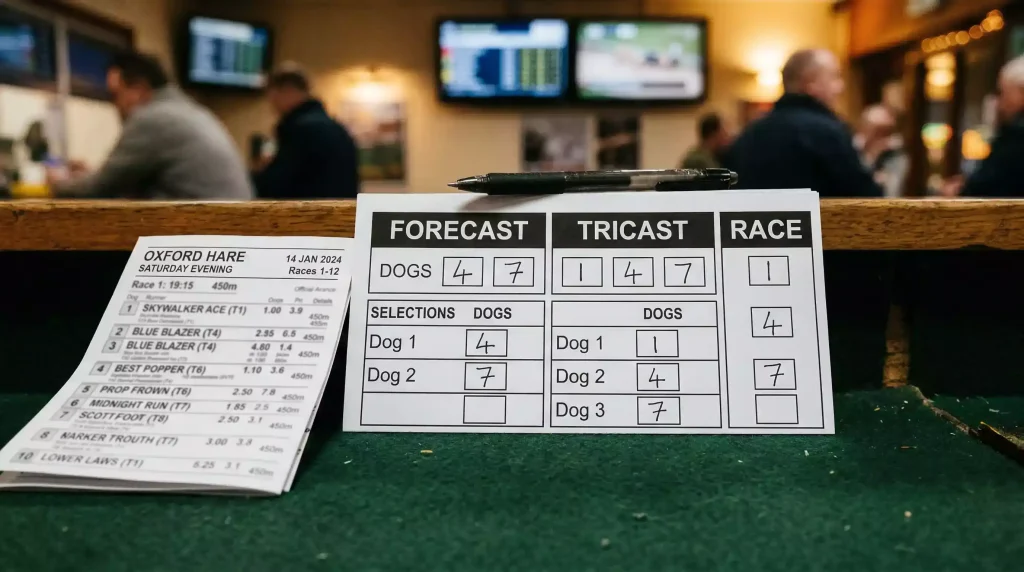
Best Greyhound Betting Sites – Bet on Greyhounds in 2026
Available in USForecasts and Tricasts Offer the Biggest Returns in Greyhound Racing
Forecast and tricast betting on Nottingham greyhounds is where the potential returns in greyhound racing reach their peak — and where most bettors’ understanding of the mechanics reaches its floor. A standard win bet pays out at the starting price. A forecast, which requires you to predict the first two finishers in the correct order, can pay multiples of that. A tricast, which extends the requirement to the first three finishers in order, can return figures that make even seasoned punters blink.
The reason these bet types matter is not just the headline payouts. Greyhound racing as a betting product generates substantial volume — bookmaker shop turnover alone reached £794 million in the 2023-24 period — and forecast and tricast pools account for a meaningful portion of that figure. They are not niche bets. They are a central part of the greyhound betting ecosystem, particularly at tracks like Nottingham where the six-dog fields and regular schedule create a steady stream of opportunities.
The challenge is that the mathematics behind forecasts and tricasts are less intuitive than a simple win bet. The dividend is not determined by fixed odds but by a pool system, the number of permutations expands rapidly, and the relationship between favourites and outsiders reshapes the expected returns in ways that are not obvious at first glance. This guide breaks down each bet type, explains how the returns are calculated, and works through examples using the kind of results you would see on a typical Nottingham card.
The wider context is set out in our Nottingham greyhound results hub.
Forecast Types: Straight, Reverse and Combination
A straight forecast is the simplest form: you name the first and second finisher in exact order. If you select Trap 3 to win and Trap 1 to finish second, both must finish in precisely those positions for your bet to pay. A straight forecast is a single bet at a single unit stake, and the dividend is determined by the computer straight forecast (CSF) calculation, which factors in the starting prices of both runners. The less predictable the outcome, the higher the dividend — which is why a 10/1 shot finishing ahead of the 2/1 favourite produces a much larger payout than the favourite beating the second favourite.
The favourite factor is worth understanding here. Across UK greyhound racing, favourites win roughly 30 to 40 percent of races. That means in the majority of races, the favourite does not win — and when the favourite fails, the forecast dividend tends to increase because the actual result was less likely than the market-expected result. If you have a method for identifying races where the favourite is vulnerable, straight forecasts become a particularly efficient way to capitalise on that edge.
A reverse forecast covers both possible orders of two selected runners. If you pick Trap 3 and Trap 1, you win if Trap 3 finishes first and Trap 1 second, or if Trap 1 finishes first and Trap 3 second. The cost is double a straight forecast — two units instead of one — because you are effectively placing two straight forecasts. The return is whichever of the two possible CSF dividends applies to the actual finishing order. A reverse forecast is the natural choice when you are confident two dogs will fill the first two places but uncertain about which will be in front.
A combination forecast extends the concept further. You select three or more dogs and cover every possible first-and-second permutation among them. With three selections, there are six possible straight forecasts (3 choices for first x 2 remaining for second). With four selections, there are twelve. The stake multiplies accordingly — a three-dog combination forecast costs six units, a four-dog version costs twelve. The trade-off is obvious: broader coverage increases your chances of landing a winning combination, but it also increases the total stake, which means the dividend needs to be large enough to cover the extra outlay.
At a Timeform-level of analysis, the key decision is whether the added coverage of a reverse or combination forecast justifies the additional cost. If your form study points strongly to a specific finishing order, the straight forecast maximises your return per unit staked. If there is genuine uncertainty about which of two or three dogs will lead the other home, the combination forecast ensures you do not miss a payout through a marginal call on finishing order.
Tricast Mechanics and Payout Structures
A tricast takes the forecast principle and adds a third position: you must predict the first, second and third finishers in exact order. The mathematical consequence of that extra requirement is dramatic. In a six-dog greyhound race, there are 120 possible tricast outcomes (6 x 5 x 4). A straight tricast covers just one of them. The improbability of correctly naming all three in order is why tricast dividends routinely reach into the hundreds and occasionally into the thousands of pounds for a one-pound unit stake.
The tricast dividend is calculated using a formula based on the starting prices of all three placed runners, adjusted for the total number of runners in the race. This is the computer tricast calculation, and like its forecast counterpart, it tends to produce larger dividends when the placed runners include outsiders. A tricast comprising the first, second and third favourites might return £15 to £30. A tricast involving a 10/1 winner, a 6/1 second and a 12/1 third could return several hundred pounds.
As with forecasts, you can place a combination tricast by selecting more than three dogs and covering all possible ordered permutations of three. With four selections, there are 24 possible straight tricasts. With five, there are 60. The stake escalates quickly, which is why combination tricasts are typically reserved for races where you have a strong shortlist of contenders but cannot separate them definitively. The five-dog combination tricast, at 60 units, needs a substantial dividend to be profitable — but in the right race, those dividends exist.
The structural reality of tricast betting is that it rewards precision over frequency. You will lose the majority of tricast bets. The ones you win need to return enough to cover the losses and generate a surplus. This is a fundamentally different staking proposition from win betting, where a 30 to 40 percent strike rate on favourites can sustain a level-stakes approach. Tricast betting demands a higher tolerance for losing runs and a sharper selection process, because each bet attempts something that is, by definition, unlikely.
The wider market is covered in the betting guide.
Worked Examples from Recent Nottingham Races
Theory is useful. Numbers are better. Here is how forecast and tricast returns work in practice, using the kind of results you would encounter on a typical Nottingham evening card.
Consider a 480-metre A3 race where the SP favourite goes off at 2/1, the second favourite at 3/1, and the remaining runners are priced between 5/1 and 10/1. If the favourite wins and the second favourite finishes second — the most market-expected outcome — the CSF might return approximately £8 to £10 for a £1 straight forecast. That is a modest return, reflecting the fact that the market considered this result the most probable. The tricast for the same race, with a 5/1 shot finishing third, might return £35 to £50 — better, but still within the range of a predictable outcome.
Now consider the same race, but with a different result. The 8/1 outsider wins, the 5/1 shot finishes second and the favourite trails in third. The CSF for this straight forecast jumps significantly — perhaps £60 to £90 — because the finishing order contradicted the market expectation. The tricast, incorporating the favourite in third, could return £150 to £250 or more. This is the dynamic that makes forecasts and tricasts appealing: when the market gets it wrong, the returns escalate sharply.
The practical lesson from Nottingham is that the standard-distance races at 480 and 500 metres — where the fields are deepest and the grading is tightest — produce the most interesting forecast and tricast opportunities. Tight grading means the dogs are closely matched, which increases the likelihood of non-obvious finishing orders. A race where the SP favourite is 6/4 and the outsider is 4/1 has a compressed price range, suggesting genuine uncertainty about the outcome. In these races, the forecast and tricast dividends are more likely to reward the punter who has studied the form beyond the obvious favourite.
Conversely, sprint races at 305 metres tend to produce lower forecast dividends because the trap draw so heavily influences the outcome that the market can price the first two places with relative confidence. If you are looking for value in forecasts and tricasts at Colwick Park, the standard distances are the place to focus your effort.
