Nottingham Greyhound Stadium Distances: Sprint, Middle and Staying Trips Compared
 Available in US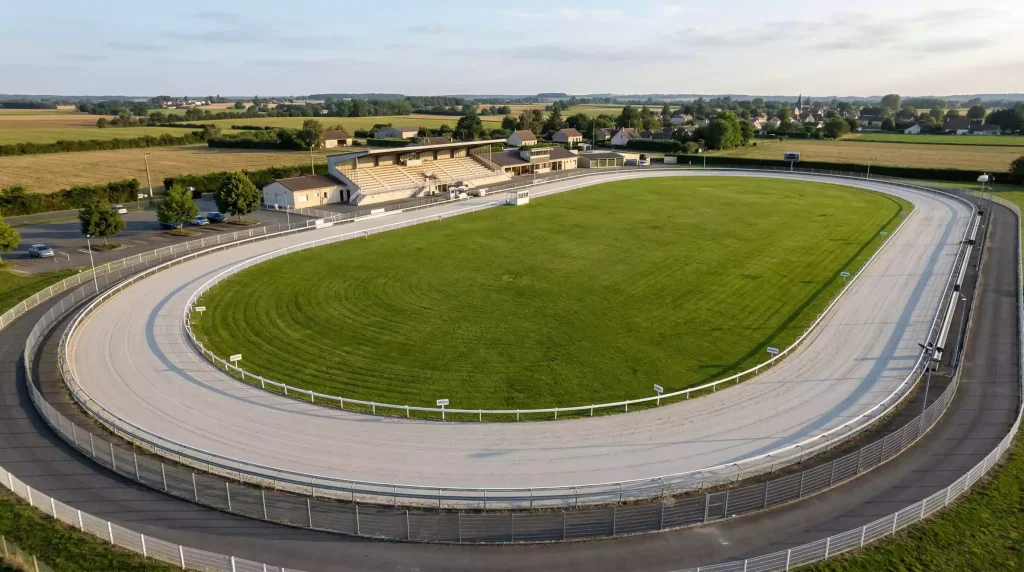
Best Greyhound Betting Sites – Bet on Greyhounds in 2026
Available in USEight Distances, Eight Different Races
Nottingham greyhound stadium distances span from a flat-out 305-metre sprint to a gruelling 925-metre marathon, and in between those extremes lie six more trip lengths that each reward a different kind of runner. Colwick Park’s eight-distance menu — 305, 480, 500, 680, 730, 885, 905 and 925 metres — is one of the broadest in UK greyhound racing, and it makes the track a uniquely demanding venue for both dogs and analysts.
The distances are not arbitrary. They are shaped by Colwick Park’s physical layout: a 437-metre circumference running on Worksop Grey sand, with an Outside Swaffham McGee hare and an 85-metre run from the traps to the first bend. That geometry determines how many bends a race includes, how much straight running is available, and how the trap draw influences the outcome. A 305-metre sprint involves one bend and a short dash. A 925-metre marathon wraps around the circuit more than twice. The tactical demands of those two races have almost nothing in common.
Every metre matters at Colwick Park. This guide breaks down each distance category — sprint, standard, middle and marathon — with an emphasis on what separates winners from the pack at each trip.
The wider context is set out in our Nottingham greyhound results hub.
Sprint Distances: 305m
The 305-metre dash is Colwick Park’s shortest trip, and it is the most unforgiving. The race covers a single bend and approximately 220 metres of straight, which means the outcome is heavily front-loaded. What happens in the first three seconds — the break from the traps, the initial acceleration, the positioning into the bend — accounts for the majority of the result. Dogs that are slow out of the boxes rarely recover, because there is simply not enough track left to make up the ground.
Trap draw matters more at 305 metres than at any other Nottingham distance. The 85-metre run to the first bend is short by greyhound standards, and inside traps — particularly Trap 1 and Trap 2 — have a structural advantage because they travel the shortest path to the bend. A dog drawn in Trap 6 at this distance needs to be genuinely faster out of the boxes to offset the extra ground it covers on the outside. When you are studying the racecard for a 305-metre race, the trap draw should be the first thing you assess, before form, before time, before anything else.
The typical runner at this distance is a compact, explosive type — lighter in frame than a stayer, with a higher proportion of fast-twitch muscle fibre. Sprint specialists rarely excel beyond 500 metres, and dogs that run well at middle distances tend to be too slow out of the traps to compete over 305 metres. If you see a dog entered at 305 metres whose recent form is entirely over 500 metres or further, treat that as a warning sign rather than a vote of versatility.
Times at 305 metres sit roughly in the 17- to 18-second range for graded races at Nottingham. Anything under 17.50 in a standard graded race is a strong performance. The margins between first and last are often tight — one or two lengths can separate the entire field — which makes 305-metre races simultaneously unpredictable as individual events and quite patterned as a category. The fast break wins. That is the sprint equation, and at Colwick Park it holds more consistently than at tracks with a longer run to the first bend.
Standard Distances: 480m and 500m
The 480-metre and 500-metre distances are Colwick Park’s bread and butter — the trips that host the largest volume of races, the deepest fields and the majority of graded competition. They are also the distances at which Nottingham has its most famous benchmark: the 500-metre track record of 29.05 seconds, set by Skywalker Logan during the first round of the 2019 English Greyhound Derby.
Both distances involve two bends and a significant portion of straight running. The difference between 480 and 500 metres is the starting position: the 500-metre start gives dogs an extra 20 metres before the first bend, which slightly reduces the trap-draw advantage for inside runners. That additional runway means speed out of the boxes is still important but marginally less decisive than at 305 metres. Dogs drawn in Trap 5 or Trap 6 have a fractionally better chance of finding a clear run into the first bend at 500 metres than they do at 480.
The standard distances are where the balance between early pace and sustained speed is most visible. A dog that leads to the first bend but fades in the back straight was fast enough to get to the front but not fit enough to stay there. A dog that comes from fourth at the bend to win by two lengths on the run-in has genuine closing speed — a trait that makes it dangerous in any field. Sectional times are most useful at these distances because you can clearly separate early pace from finishing effort and assess which component is stronger.
For bettors, the 480- and 500-metre races are where form is most reliable. The fields are typically well-graded, meaning the dogs are closely matched on ability, and the two-bend format rewards the runner that combines tactical pace with stamina rather than relying on a single burst. If you are building a methodology for Nottingham, the standard distances are the place to start. The data is deepest, the patterns are clearest, and the competition is fairest.
The record over each trip is in the track records.
Middle Distances: 680m and 730m
The 680- and 730-metre distances introduce a third and, in the case of 730 metres, a fourth bend into the equation, and that changes the tactical landscape fundamentally. At these trips, early pace still matters — no greyhound wants to be trapped in traffic at the first bend — but it is no longer the dominant factor. Stamina, race intelligence and the ability to maintain speed around multiple bends become increasingly important.
At 680 metres, the race covers three bends and roughly one and a half laps of Colwick Park’s 437-metre circuit. Dogs that excel at this distance tend to be slightly heavier than sprint specialists, with a longer stride and the aerobic capacity to sustain effort well beyond the first 300 metres. The trap draw is still relevant but less predictive: the race is long enough that a poor draw can be overcome by a dog with superior pace in the second half of the race.
The 730-metre trip adds another full bend and pushes the race to nearly two laps. This is where the transition from “fast dog” to “strong dog” becomes most apparent. A runner that leads by three lengths at the second bend but is caught on the final straight was fast enough for 500 metres but not strong enough for 730. Conversely, a dog that races in mid-pack through the first lap and then picks off runners one by one in the closing stages has the stamina profile that this distance demands.
Middle distances also tend to produce more interference incidents, simply because the field spends more time running together in close quarters around bends. When reviewing form from 680- and 730-metre races, the running comments become especially valuable. A dog that finished fourth but was “checked bend 3” and “crowded final bend” may have been the best runner in the race on raw ability — it just never got a clear run. At shorter distances, such incidents are less common because the fields spread out more quickly.
Marathon Trips: 885m, 905m and 925m
Nottingham’s three marathon distances — 885, 905 and 925 metres — sit at the far end of the spectrum and represent a niche category that relatively few greyhounds are equipped to contest. These races cover more than two full laps of the circuit, involving five or more bends and demanding a sustained effort that separates genuine stayers from dogs that simply lack the speed for shorter trips.
The distinction between the three marathon distances is subtle in metre terms but significant in racing terms. The 885-metre trip involves a different starting position from the 905 and 925, which affects how dogs approach the first bend. At 925 metres, the longest trip on the card, the extra 40 metres of ground compared to 885 can make the difference between a dog that finishes strongly and one that empties in the final 100 metres. Stamina is not a binary trait; it grades on a spectrum, and these three distances test different points along that spectrum.
Marathon runners at Colwick Park are typically the heaviest dogs on the card — not in fat, but in lean muscle mass and skeletal frame. They carry the physical structure to sustain speed over extended distances but often lack the explosive acceleration that sprint dogs possess. Their form figures tend to be more consistent than sprinters’ because marathon races are less affected by trap-draw luck and first-bend incidents. The longer the race, the more the result reflects genuine ability and fitness rather than circumstance.
For bettors, the marathon distances present a paradox. The form is more reliable, but the fields are smaller and the sample sizes are thinner. Nottingham does not programme marathon races on every card — they tend to appear on specific meeting days and in specific grades. That scarcity means the going and track conditions at the time of the race carry outsized influence, because you may be comparing a dog’s time from three weeks ago with one from today, across different going conditions, with no intermediate data point to bridge the gap.
The 925-metre race is, in many respects, Colwick Park’s ultimate test of a greyhound. It demands speed, strength, stamina and tactical awareness. Dogs that win at this distance repeatedly are rare and valuable, and their form profiles often tell stories that shorter-distance runners simply cannot match. If the sprint is about the first three seconds, the marathon is about the last three — and those final strides, after two laps of effort, reveal more about a dog’s quality than any other moment in greyhound racing.
