Nottingham Greyhound Form Guide: Sectional Times, Grades and Performance Patterns
 Available in US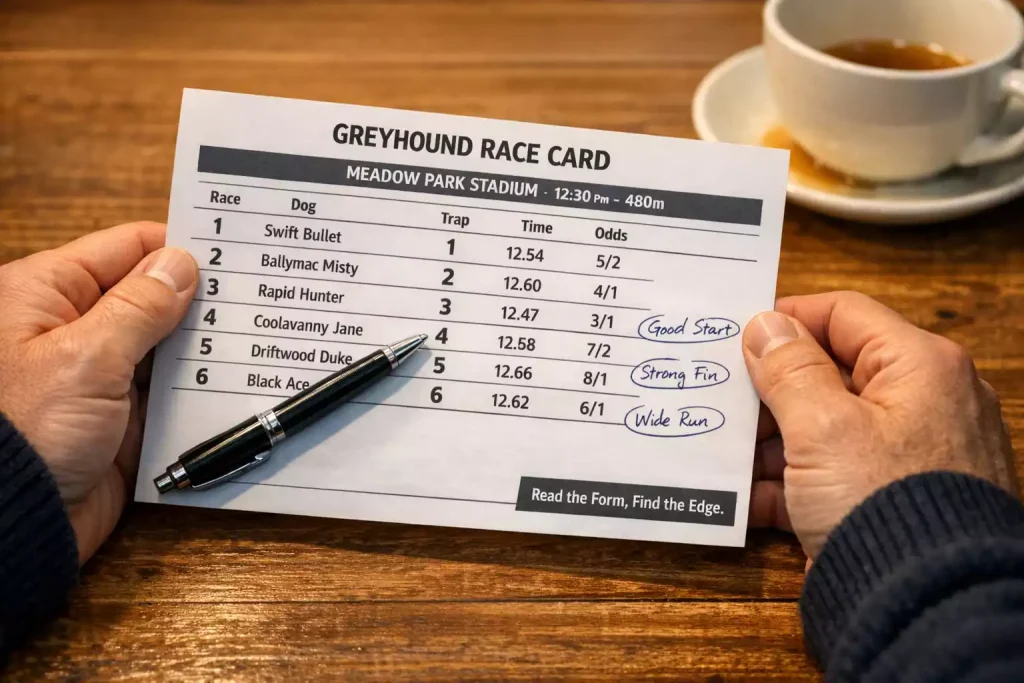
Best Greyhound Betting Sites – Bet on Greyhounds in 2026
Available in USWhat Separates Informed Punters from Casual Ones at Nottingham
There are two kinds of people at a Nottingham greyhound meeting. The first group picks a trap number, maybe the dog with the best name, places a bet and hopes for the best. The second group opens a racecard, scans the form digits, checks the sectional times, notes the grade and the going, and makes a selection based on evidence. Both groups can win on any given race. Over a season, only one of them tends to come out ahead.
This Nottingham greyhound form guide is written for anyone who wants to cross from the first group to the second. Form — the record of a dog’s recent performances expressed in numbers, symbols and abbreviations — is the single most important tool available to punters. At Colwick Park, where eight different distances create a more complex racing programme than most UK tracks, reading form properly is not optional. It is the difference between an informed opinion and a guess.
The challenge is that greyhound form looks impenetrable at first glance. A racecard is a wall of numbers, letters and shorthand that makes perfect sense to experienced racegoers and absolutely none to newcomers. Columns labelled with cryptic headers, form figures like “321456” that read like a phone number, times expressed to hundredths of a second, grades that range from A1 to A11 with open races sitting somewhere above — none of it is intuitive, and very little of it is explained at the track itself.
This guide works through it all, step by step, from the basic racecard columns to the advanced concept of calculated times. By the end, you should be able to pick up a Nottingham racecard and read it the way a professional analyst does — not just recognising what each number means, but understanding how the numbers interact to tell you which dog is likely to run well tonight. Read the form, find the edge.
The full picture is in our Nottingham greyhound results hub.
Decoding the Racecard: Every Column Explained
A greyhound racecard is a compressed database. Every column contains a specific piece of information, and together they form a complete picture of the race. Here is what you are looking at when you open a Nottingham racecard, column by column.
Trap Number and Colour
The first column shows the trap number — 1 through 6 — alongside the corresponding jacket colour. Trap 1 is red, Trap 2 is blue, Trap 3 is white, Trap 4 is black, Trap 5 is orange, and Trap 6 is black and white stripes. These colours are standardised across all UK tracks and are your primary way of identifying dogs during a race. At Nottingham, you will sometimes see reserve runners listed as Trap R1 or R2, who replace withdrawn dogs.
Dog Name and Trainer
The dog’s registered racing name appears next, followed by the trainer’s name or initials. Trainer information matters more than casual punters realise. Certain trainers consistently produce results at Nottingham because they know the track, understand how their dogs handle the Colwick Park bends, and time their entries to exploit grade advantages. Over time, you will start to recognise which trainers are reliable at which distances.
Form Figures
This is the column that intimidates newcomers and excites experienced punters. Form figures are a string of digits — typically the last six runs — showing where the dog finished in each race. A form line of “111234” means the dog won its last three races then finished second, third and fourth in the three before that. The most recent run is on the right.
But the numbers alone are not the full story. Look for additional letters embedded in the form. A “T” indicates a trial run, not a competitive race. An “F” means the dog fell. “D” means disqualified. A dash or hyphen represents a break in racing — the dog was off the track for a period. At Nottingham, where dogs race on a regular weekly cycle, a break of more than two weeks is worth noting because it might indicate an injury, a change of kennel, or a deliberate rest before a big race.
Best Time and Recent Time
The racecard usually shows two times: the dog’s best recorded time at the relevant distance and its most recent time. These are expressed in seconds to two decimal places — for example, 29.45 over 500 metres. The best time tells you the dog’s ceiling, what it is capable of in ideal conditions. The recent time tells you where it is performing right now. A dog whose best time is 29.20 but has been running 29.80 in its last three outings is either off-form, returning from injury, or racing in conditions that slow it down. Conversely, a dog whose recent times are approaching its personal best is likely in peak condition.
At Nottingham, where the track record over 500 metres stands at 29.05 seconds — set by Skywalker Logan during the 2019 English Greyhound Derby — any dog running within half a second of that benchmark is operating at an extremely high level. Most graded racers will be running several seconds slower, and that is perfectly normal. The track record exists as a reference point, not an expectation.
Grade
The grade column shows the classification of the race and, by extension, the class of dog. Nottingham uses the standard GBGB grading system, which runs from A1 at the top of the graded ranks down through A2, A3 and so on. We will explore this system in detail later in this guide, but for racecard purposes, the grade tells you the approximate quality of competition. An A1 race at Nottingham features the best graded dogs at the track. An A7 race features dogs that are slower, less consistent, or both.
Weight
Racing weight is listed in kilograms. A greyhound’s ideal racing weight is specific to the individual, and trainers monitor it closely. A dog listed at 32.5kg that was 33.0kg a fortnight ago has lost half a kilo — which could indicate increased fitness or a problem. Weight changes of more than a kilo between races are worth investigating. Consistent weight is generally a positive indicator: it suggests the dog is healthy, settled in training and ready to race.
Comments and Race Notes
The final column often contains abbreviated race comments from the previous outing. These describe how the dog ran — “led,” “railed,” “challenged wide,” “bumped first bend” — and are essential for understanding why a finishing position happened. A dog that finished fourth but was “bumped and crowded first bend” may have been unlucky rather than slow. A dog that won but is described as “unchallenged, led all” probably benefited from a weak field rather than demonstrating improvement. Reading the comments alongside the form figures gives you a three-dimensional picture that numbers alone cannot provide.
Sectional Times and Calculated Times: The Hidden Layer
If the racecard is the public face of greyhound data, sectional times are the backstage pass. They reveal what the finishing time alone cannot: how a dog distributed its effort across different phases of the race. At Nottingham, where races range from 305 metres to 925 metres, sectional analysis is particularly valuable because it distinguishes between dogs that are fast everywhere and dogs that are fast only at certain points.
What Sectional Times Measure
A sectional time, also called a split time, records how long a dog takes to cover a specific portion of the race. The most common split is the time to the first bend — the initial phase from trap to the first turn. At Nottingham, with an 85-metre run to the first bend, this opening split measures early pace: how quickly the dog breaks from the box and reaches the bend.
A fast first-bend time indicates a sharp breaker, a dog that is likely to be at or near the front when the field reaches the first turn. A slow first-bend time suggests a dog that is either a naturally slow starter or one that tends to find its stride later in the race. Neither is inherently better — it depends on the distance and the specific race conditions — but the information is critical for predicting how the race will unfold.
Beyond the first bend, additional splits may cover the back straight and the run to the line. Some data providers break a 500-metre race into three or four sections, while others focus only on the first and last splits. The level of detail varies between sources, but even a single first-bend time adds enormous value to your analysis.
Where to Find Sectional Data
Sectional times are not always printed on the standard racecard handed out at the track. You will typically find them through specialist data providers such as Timeform, Greyhound Recorder, and dedicated statistics websites. Some bookmaker platforms also display split data alongside their racecards. For Nottingham specifically, GBGB maintains race results that include basic timing data, though the level of sectional detail varies.
The key is to build a routine. Before a Nottingham meeting, pull up the racecard and then cross-reference the entries against a sectional data source. Look at the first-bend times for each dog in the race and note where each runner is likely to be positioned at the first turn. This alone gives you a rough picture of the race shape before it happens.
Calculated Times: The Adjustment Layer
Raw times are useful but imperfect. A dog that ran 29.40 over 500 metres on a fast-going Monday evening is not directly comparable to one that ran 29.80 over the same distance on a slow-going Thursday morning. The conditions were different, and the times reflect conditions as much as ability.
This is where calculated times come in. A calculated time — sometimes called an adjusted time or a rated time — takes the raw finishing time and adjusts it for track conditions, specifically the going and any timing anomalies. The adjustment produces a figure that represents what the dog would theoretically have run on a standard-going track. Calculated times allow you to compare performances across different meetings, different weeks and even different seasons.
Timeform is the best-known provider of calculated times in UK greyhound racing. Their adjusted figures strip out the noise of going variations and produce a standardised speed rating that makes cross-meeting comparison possible. If Dog A has a calculated time of 29.10 and Dog B has a calculated time of 29.35, you can be reasonably confident that Dog A is genuinely faster, regardless of when they each last raced.
Using Sectional Data in Practice
The practical application is straightforward. First, identify each dog’s first-bend split. Dogs with fast first-bend times drawn in inside traps are likely to lead through the first turn — a powerful combination. Dogs with slow first-bend times drawn wide are likely to be at the back of the field early, needing a strong finish to challenge.
Second, compare calculated times rather than raw times when assessing overall ability. A dog that has been running calculated times of 29.20 consistently is a stronger performer than one whose raw times look similar but whose calculated figures are a second slower once going adjustments are applied.
Third, watch for the pattern of sectional splits across multiple races. A dog that always starts slowly but finishes strongly is a “closer” — it needs the race to unfold a certain way. A dog that leads early but fades in the final section is a “front-runner” that may struggle in strongly run races. At Nottingham, where the 500-metre trip involves two bends and two straights, race shape matters enormously. Sectional data is how you predict it.
The Grading System at Nottingham: A1 Through Open
Every greyhound at Nottingham is assigned a grade, and that grade determines which races it can enter. The grading system is not just bureaucratic housekeeping. It is the mechanism that keeps competition fair, ensures fields are competitive, and — for punters — provides one of the most reliable indicators of a dog’s ability level.
The Grade Ladder
Nottingham uses the standard GBGB classification system. Graded races run from A1 at the top down to A11 at the bottom. A1 dogs are the fastest and most consistent performers in the standard racing programme. A11 dogs are either young and unproven, returning from a long absence, or simply not as quick. Between those extremes, the grades create a ladder where each step represents a measurable difference in performance.
The scale of the system is worth appreciating. In 2026 alone, GBGB-licensed tracks across the UK hosted 355,682 individual greyhound runs. Each of those runs was graded, classified and recorded. The grading system is what makes this volume of racing manageable — it sorts thousands of dogs into appropriate competition levels so that every race has a field of roughly equal ability.
How Grades Are Assigned
A dog’s grade is determined primarily by its recent times at the specific track where it is racing. When a greyhound first arrives at Nottingham, it typically undergoes a series of trial runs to establish a baseline time. That time is then used to assign an initial grade. If the dog runs 29.50 over 500 metres and that corresponds to A4 level at Nottingham, it enters the racing programme at A4.
From there, performance adjusts the grade. A dog that wins a race is usually promoted — moved up one grade for the next race. A dog that finishes last or outside the places may be dropped down. This promote-and-relegate mechanism keeps the grading system dynamic. A dog that wins three A5 races in a row will find itself racing in A2 or A3 within a few weeks, facing stiffer competition. A dog that struggles at A3 will drop back to A4 or A5, where it has a better chance.
Open Races
Above the graded system sits a category of open races. These are not restricted by grade — any dog can enter, provided the trainer enters it and the race conditions are met. Open races at Nottingham include events like the Eclipse and the Select Stakes, which attract the best dogs from Colwick Park and visiting runners from other tracks. The prize money is higher, the competition is fiercer, and the form analysis is correspondingly more complex because you are comparing dogs that may never have raced against each other before.
Open races are where the grading system’s limitations become visible. A dog rated A1 at Nottingham might be A3 level at a track with stronger competition. In open events, the grade becomes less useful than raw form, times and sectional data.
Why Grades Matter for Betting
For punters, the grade is a quick-and-dirty quality filter. If you see a dog dropping from A3 to A5 on the racecard, that dog has been struggling at a higher level and is now facing easier opposition. All else being equal, a dog dropping in grade has a statistical advantage over one that is rising. The market usually reflects this — grade droppers tend to be shorter in the betting — but not always efficiently.
The inverse is also worth watching. A dog rising from A6 to A4 after consecutive wins may be genuine — a young, improving runner finding its level — or it may be about to hit a ceiling. The times tell you which. If the dog’s winning times at A6 were comfortably faster than typical A4 times, the promotion is justified. If the times were borderline, the dog may struggle at the higher grade. This is where the racecard data and the grading system intersect, and where form analysis begins to produce genuine insight rather than pattern-matching.
Going and Track Conditions: How Weather Changes Form
A dog’s form figures exist in context, and the most important context of all is the going. Two runs that produce identical times can represent vastly different levels of performance if the track conditions were different. Understanding how going affects form at Nottingham is essential for anyone who wants to compare performances accurately.
Nottingham’s Surface
Colwick Park uses Worksop Grey sand as its racing surface. This is a widely used material in UK greyhound racing, chosen for its drainage properties and consistency. The track runs an Outside Swaffham McGee hare on a 437-metre circumference, and the surface is maintained by groundstaff who water and grade it between meetings.
Sand surfaces respond to weather in predictable ways. Heat dries the surface out, making it faster. Rain saturates it, slowing dogs down. Cold temperatures can harden the surface, producing times that sit somewhere between fast and slow. Each of these conditions produces a different going rating, and each going rating requires a different approach to form analysis.
Going Categories
UK greyhound racing uses a simplified going scale. The standard categories, from fastest to slowest, are: fast, normal (or standard), slow, and very slow. Some tracks add intermediate descriptions, but these four cover the range you will encounter at Nottingham.
On a fast going at Nottingham, dogs run at or near their best times. The surface is firm, grip is good, and the rail provides a clean racing line. On slow going, times increase across the board — sometimes by half a second or more over 500 metres. That half-second sounds small, but it represents several lengths at racing pace. A dog that ran 29.40 on fast going and 29.90 on slow going has not necessarily lost ability. It has simply been slowed by the surface.
Going Allowance
The concept of going allowance formalises this adjustment. A going allowance is a time correction applied to account for the difference between the actual going and a standard baseline. If the going at Nottingham is declared slow with an allowance of +0.40 seconds over 500 metres, it means that every dog’s time that night will be approximately 0.40 seconds slower than it would be on a standard surface.
This allowance is the bridge between raw times and calculated times. When you see a dog’s calculated time on a data platform, the going allowance has already been factored in. The calculated figure represents what the dog would have run on a standard-going track, allowing direct comparison between performances on different nights.
For punters doing their own analysis, the going allowance is the single most important adjustment to make. If you are comparing two dogs ahead of a Nottingham meeting and one ran its best time on fast going while the other set its best time on slow going, the raw numbers may look similar but the underlying performances are not equal. The dog that ran faster on slower going is, adjusted for conditions, the superior performer.
When Going Changes Mid-Meeting
At Nottingham, meetings typically run twelve to fourteen races over two to three hours. During that time, the going can change. An evening meeting that starts on fast going may see the surface slow down as dew settles. A morning meeting after overnight rain may start slow and dry out as races progress. This means that dogs racing in the first few races face different conditions than those in the later races on the same card.
Experienced racegoers watch the early race times to gauge how the going is running. If the first three races produce times consistently half a second slower than recent meetings at the same grade level, the going is likely on the slow side, and adjustments should be made for later races accordingly. This is a small detail, but small details accumulate into a meaningful edge over the course of a season.
The splits behind the form are in sectional times.
Building a Form Profile: Putting It All Together
You have now seen the individual components — racecard columns, sectional times, grades and going adjustments. The final step is combining them into a coherent form profile for each dog in a race. This is where analysis becomes decision-making.
Why Every Hundredth of a Second Counts
A greyhound can reach a top speed of approximately 72 kilometres per hour in just six strides, according to physiological studies of the breed. At that velocity, a tenth of a second covers roughly two metres. In a six-dog race where the field is separated by a length or two, the difference between first and fourth might be 0.15 seconds. This is why form analysis at the level of hundredths of a second is not pedantic. It is proportionate to the margins that decide races.
A Pre-Race Analysis Routine
Here is a step-by-step process you can follow before any Nottingham meeting. It is not the only approach, but it covers the essential ground.
First, check the going. Before you look at a single dog, know the track conditions. Is the going fast, normal or slow? What was it at the last meeting? If it has changed, your historical comparisons need adjusting. Make a mental note of the going allowance if one is available.
Second, scan the grades. Look at the grade of each race and note any dogs that are dropping or rising. Grade droppers are immediate candidates for closer inspection. Grade risers need their times tested against the new level of competition.
Third, compare calculated times. For each race, line up the calculated times or going-adjusted times of all six runners. This is your baseline comparison — the closest thing to a level playing field. The dog with the fastest calculated time is not guaranteed to win, but it is the most likely starting point for your selection.
Fourth, check the sectional splits. Look at first-bend times for each runner, then cross-reference with the trap draw. A dog with a fast first-bend time drawn in Trap 1 is likely to lead from the start. A dog with a slow first-bend time drawn in Trap 6 will probably be at the back early. Map out the probable race shape: who leads, who chases, who finishes late.
Fifth, read the recent form comments. The comments from each dog’s last two or three races tell you whether its finishing positions were earned or circumstantial. A dog that finished third but was bumped at the first bend and ran on strongly is a better proposition than one that finished second in a slow race with no trouble in running. Context converts numbers into narrative.
Sixth, factor in the draw. On sprint distances, weight the trap draw more heavily. On staying trips, weight it less. If your top pick on calculated times is drawn in a statistically weak trap on a 305-metre sprint, that is a flag — not a disqualification, but a reason to check whether the second-best dog in a stronger trap might offer better value.
When the Form Contradicts Itself
Sometimes the data points in different directions. The calculated times say Dog A is the fastest, but its first-bend splits are slow and it is drawn wide. Dog B is slightly slower on adjusted times but breaks sharply and is drawn in Trap 1. Who do you back?
There is no formula that resolves every contradiction. But the guiding principle is this: weight the factors that are most relevant to the specific race. On sprints, where the first bend decides most outcomes, prioritise early pace and trap position. On standard and middle distances, prioritise calculated times and overall form. On staying trips, prioritise stamina, consistency and late-race sectional data.
The quality of this analysis depends on the quality of the data underneath it. UK greyhound racing has invested heavily in data transparency over recent years. “It shows that the initiatives we have introduced in recent years are now embedded and are helping to consolidate the significant progress we have made since 2018 across all measures,” Mark Bird, Chief Executive of GBGB, observed in a 2026 welfare report — a statement that reflects the governing body’s broader commitment to rigorous data collection. That commitment benefits punters directly: every race time, every sectional split, every going report feeds into a dataset that makes serious form analysis possible at tracks like Nottingham.
Form analysis is a skill, and like any skill, it improves with practice. The first time you work through a Nottingham racecard using this framework, it will feel slow and uncertain. By the tenth time, it will be second nature. By the fiftieth, you will be spotting patterns that the market misses — and that is where the edge lives.
