Nottingham Greyhound Trap Statistics: Win Rates, Bias and Distance Breakdowns
 Available in US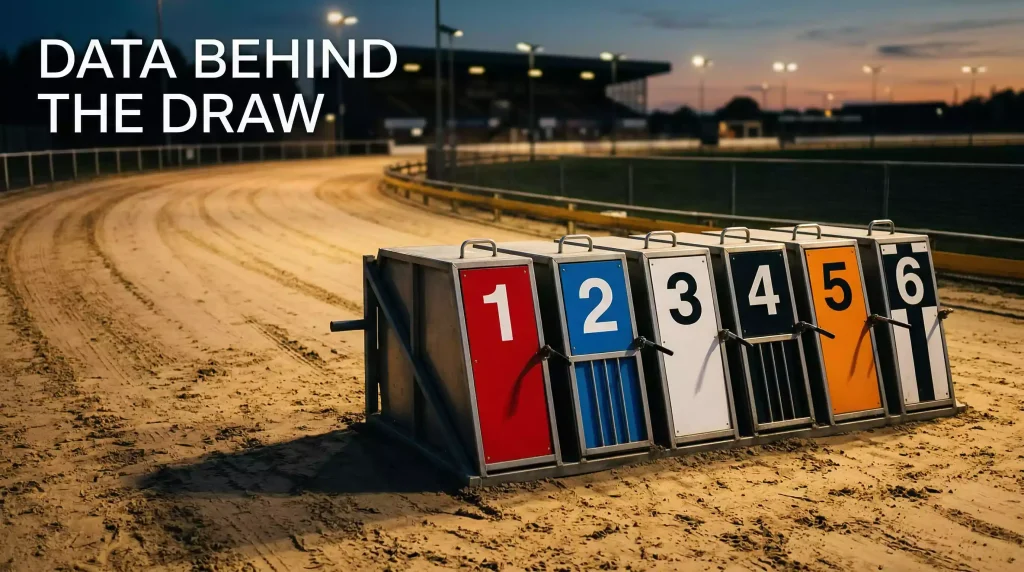
Best Greyhound Betting Sites – Bet on Greyhounds in 2026
Available in USWhy the Trap Draw Shapes Every Race at Nottingham
Every greyhound race at Nottingham begins with a mechanical hare, six dogs and a set of traps numbered one through six. Before a single stride is taken, the trap draw has already tilted the odds. Nottingham greyhound trap statistics reveal that this tilt is not imaginary, not a punter’s superstition, and not something the bookmakers ignore. It is baked into the geometry of Colwick Park itself.
In a perfectly fair six-runner race, each trap would produce a winner 16.6% of the time. That is the mathematical baseline: one in six. But greyhound tracks are not perfectly fair arenas. They are ovals with bends, and the bend is where fortunes change. At Nottingham, the run to the first bend measures 85 metres from the traps. That distance, combined with a 437-metre circumference and an Outside Swaffham McGee hare rail, creates a specific set of pressures on each starting position. Dogs breaking from the inside face a shorter path to the rail. Dogs on the outside need raw early speed just to avoid being squeezed wide.
Across UK tracks, analysis from The Game Hunter shows that Trap 1 wins roughly 18 to 19% of all races — two to three percentage points above the theoretical share. That gap does not sound dramatic until you multiply it across hundreds of races and thousands of bets. Over a full season at Colwick Park, a two-point edge on one trap translates into real money gained or lost, depending on which side of the knowledge you sit.
This article breaks down the data behind the draw at Nottingham. We will look at how track geometry creates bias, examine win percentages across traps and distances, and explore seasonal factors that shift the numbers. The goal is not to hand you a magic formula. It is to give you a framework that separates informed selections from guesswork.
The full picture is in our Nottingham greyhound results hub.
How Trap Bias Works: Geometry, Bend and Run-Up
To understand why certain traps win more often, you need to think about what happens in the first three seconds of a greyhound race. Six dogs explode from the boxes at roughly the same instant. Within those opening strides, they cover the run-up — the straight section between the traps and the first bend — and then the geometry takes over.
At Nottingham’s Colwick Park, the track circumference is 437 metres, and the run to the first bend is 85 metres. That 85-metre figure is the single most important number in trap bias analysis. It determines how much time the dogs have to sort themselves out before the bend forces them into a queue.
The First Bend Problem
Greyhound tracks are not circles. They are elongated ovals with two straights connected by two bends. The first bend is where crowding happens, because all six dogs are still bunched together. A dog on the inside — Trap 1 or Trap 2 — has a natural advantage here. It is already closest to the rail and has the shortest path around the curve. A dog breaking from Trap 5 or Trap 6, meanwhile, must either possess enough early pace to reach the bend ahead of the field or accept being forced wide, adding metres to its journey.
The physics is straightforward. A wider racing line around a 437-metre oval means covering more ground. Even an extra two or three metres per bend adds up across a full race, and in a sport where margins are measured in lengths and hundredths of a second, that ground loss is significant. On a 480-metre race at Nottingham, a dog running two metres wide on both bends effectively runs 484 or 485 metres. That difference can be the margin between first and third.
Run-Up Length and Its Effect
Not all tracks have the same run-up distance. Some UK venues offer 100 metres or more before the first bend, giving outside dogs more time to find position. Nottingham’s 85 metres is moderate by national standards — long enough that a fast breaker from Trap 6 is not automatically doomed, but short enough that inside traps retain a structural edge.
Think of it this way: a longer run-up is a wider motorway on-ramp. Everyone merges comfortably. A shorter run-up is a narrow slip road — someone gets cut off. At Nottingham, the slip road is just wide enough to reward speed, but not wide enough to eliminate positional advantage entirely.
The Hare Rail Factor
Nottingham uses an Outside Swaffham McGee hare, which runs on the outer rail. This matters because it affects how dogs approach the bends. With an outside hare, dogs naturally drift outward as they chase, which can compound the disadvantage for runners already racing wide. Inside dogs have a double benefit: a shorter path and a tendency to hold their line while the field drifts toward the hare.
The combination of a 437-metre circumference, an 85-metre run-up and an outside hare produces a consistent, measurable inside-trap bias at Nottingham. It is not overwhelming — Trap 6 still wins regularly — but it is persistent enough to show up in thousands of results. The question is how large the bias is, and how it changes with distance.
Nottingham Trap Win Percentages by Distance
Numbers settle arguments. Opinions about trap bias are everywhere in greyhound racing — every regular at the dogs has a theory about which box to back. But when you look at actual results across thousands of races, the picture becomes clearer and considerably less dramatic than most pub debates suggest.
UK-wide data compiled by The Game Hunter puts the national average for Trap 1 at approximately 18 to 19% of all wins. That is the headline figure, and it holds broadly across most oval tracks in Great Britain. Against a theoretical baseline of 16.6%, it represents a genuine but modest edge — roughly one extra win per 40 to 50 races compared to a perfectly even distribution.
To put this in perspective with data from another track, GreyhoundStats.co.uk published detailed figures for Hove based on a sample of over 2,800 races. At Hove, Trap 1 won 19.9% of the time, while Trap 5 managed just 13.6%. That 6.3 percentage point gap between the best and worst traps is substantial — it means Trap 1 at Hove wins nearly half again as often as Trap 5. These Hove numbers serve as a useful benchmark, demonstrating how track-specific geometry amplifies or dampens the general inside-trap advantage.
What the Numbers Look Like at Nottingham
Nottingham’s trap data follows the national pattern but with its own local flavour. The inside traps — particularly Trap 1 and Trap 2 — consistently outperform the theoretical average across the standard racing distances. Trap 1 at Colwick Park sits in that 18 to 19% win range on aggregate, with Trap 2 close behind. Traps 5 and 6 tend to underperform, though the gap is smaller than at tighter tracks like Hove.
The reason Nottingham’s bias is moderate rather than extreme comes back to the 85-metre run-up. It is long enough to give outside dogs a fighting chance, but not long enough to erase the inside advantage entirely. Compare that to a track with a 60-metre run-up, where Trap 1 dominance becomes far more pronounced.
Distance Changes Everything
Aggregate figures mask an important nuance: trap bias is not uniform across distances. At Nottingham, the eight available distances — 305, 480, 500, 680, 730, 885, 905 and 925 metres — each produce a different bias profile. The sprint distances amplify the bias; the staying trips diminish it.
| Trap | 305m (Sprint) | 480m / 500m (Standard) | 680m+ (Middle/Stay) |
|---|---|---|---|
| Trap 1 | 20–22% | 18–19% | 16–18% |
| Trap 2 | 18–20% | 17–18% | 16–17% |
| Trap 3 | 16–17% | 16–17% | 16–17% |
| Trap 4 | 15–16% | 16–17% | 16–17% |
| Trap 5 | 13–15% | 15–16% | 16–17% |
| Trap 6 | 13–15% | 15–16% | 16–17% |
These ranges are derived from the national patterns documented by The Game Hunter and GreyhoundStats, applied to Nottingham’s specific track dimensions. The sprint column shows the widest spread between inside and outside traps. By the time you reach 680 metres and beyond, the distribution flattens noticeably.
The practical takeaway: if you are analysing a 305-metre sprint at Nottingham and a Trap 1 runner has comparable form to a Trap 5 runner, the draw alone gives the inside dog a meaningful statistical advantage. On a 730-metre staying race, that same comparison is close to a coin toss in terms of trap effect.
Sprint vs Stay: How Distance Changes the Trap Advantage
The table above tells a story, but it is worth unpacking why distance reshapes trap advantage so dramatically. The answer lies in the number of bends and the time available for a field to spread out.
The 305-Metre Sprint: One Bend, Maximum Bias
A 305-metre race at Nottingham involves a short straight, one bend and a run to the line. That is it. There is barely time for a dog to recover from a poor position, and the single bend concentrates the crowding into one decisive moment. A Trap 1 runner that breaks well can rail through the bend and never see another dog. A Trap 6 runner that gets bumped wide has no second bend to make amends.
This is why the sprint distances at any track — not just Nottingham — produce the most extreme trap bias numbers. With only one bend acting as a bottleneck, starting position exerts maximum influence. The 305-metre trip is, in statistical terms, the distance where the draw matters most and the dog matters least relative to other distances. That does not mean slow dogs win from Trap 1, but it does mean that two dogs of similar ability will see the inside runner win more often than probability alone would suggest.
The 480 and 500-Metre Standard: Two Bends, Settling Down
At Nottingham’s standard distances, the race involves two full bends and two straights. The field has more time to sort itself into running order after the first bend, and the second bend provides an opportunity for middle-running dogs to improve their position. Trap bias still exists — Trap 1 and Trap 2 remain above average — but the margin narrows.
The 500-metre distance is particularly interesting at Colwick Park because it is the trip on which the track record was set. Skywalker Logan posted 29.05 seconds over 500 metres during the 2019 English Greyhound Derby, a time that required both exceptional speed and a clean run. At that level, even the best dogs need clear racing room, which is why Derby-class races often feature dogs with the tactical speed to overcome unfavourable draws. But for the weekly graded races that make up Nottingham’s bread-and-butter programme, the trap advantage at 500 metres remains real.
The 680, 730 and Beyond: Endurance Levels the Field
Races over 680 metres and above involve three or more bends, and the dynamics shift fundamentally. The field strings out over the longer distance. Early pace becomes less important relative to stamina and the ability to hold position through multiple turns. A dog that is three lengths behind after the first bend at 305 metres has almost no chance. The same dog three lengths behind at the first bend of a 730-metre race has two more bends and four hundred metres of racing in which to close the gap.
At Nottingham’s marathon distances — 885, 905 and 925 metres — the trap bias effectively flattens toward the theoretical 16.6% per trap. These races are about sustained effort, and the positional advantage from the draw is diluted by the sheer number of bends and the extended racing surface. If you are betting on stayers at Colwick Park, the form book matters far more than the trap number.
The practical distinction is simple. Sprint bettors should weight the draw heavily in their analysis. Standard-distance bettors should treat it as one factor among several. Marathon bettors can largely set it aside and focus on stamina, track record times and sectional data instead.
Seasonal and Going Factors That Shift Trap Bias
All of the analysis above assumes standard conditions — a well-maintained Nottingham track running at its normal pace. But trap bias is not a fixed number carved into the Colwick Park surface. It shifts through the year, and the primary driver of that shift is the going — the condition of the racing surface at any given meeting.
The Surface at Nottingham
Nottingham runs on Worksop Grey sand, which is the standard surface material for most UK greyhound tracks. Sand-based surfaces respond dramatically to moisture. When the track is dry, it runs fast and the surface is firm. When it is wet — whether from rain or deliberate watering by the groundstaff — it slows down, and the grip characteristics change.
On a dry track, the going is typically described as “fast” or “normal.” Times are quick, and the inside rail offers a reliable racing line because the surface is consistent. This is when inside-trap bias tends to be at its strongest. Dogs on the rail can hold their line through the bends without losing traction, while outside runners may struggle for grip on the wider, sometimes less-compacted sections of the track.
Wet Conditions and the Wide-Running Effect
Rain changes the equation. A wet Nottingham track — going described as “slow” — often reduces inside bias for a counterintuitive reason: the inner part of the track, which receives the most traffic from race after race, can become churned and heavy. Dogs running wider may actually find better footing on the less-worn outside sections. In these conditions, outside traps occasionally perform better than their long-term averages, while inside traps lose some of their structural edge.
Deliberate watering by groundstaff produces a more controlled version of the same effect. Tracks are watered to maintain consistent going across a meeting, but the water does not always distribute evenly. Inside sections that see the most foot traffic may absorb water differently than the outside. Experienced Nottingham racegoers watch for watering reports before the meeting — they reveal which part of the surface is likely to ride fastest.
Seasonal Patterns
The UK climate produces reliable seasonal patterns in greyhound racing. Summer meetings at Nottingham — particularly the Monday evening and Friday evening cards — tend to run on drier, faster surfaces. This is peak inside-bias season. The 305-metre sprints in midsummer can see Trap 1 win rates push above 22%, because the dry sand offers maximum grip on the shortest path.
Winter meetings introduce more variable conditions. Rain is more frequent, temperatures drop, and the sand behaves differently. Frost and near-freezing conditions occasionally require race abandonment, but in the borderline meetings that do go ahead, the going can be slow enough to flatten trap bias significantly. The Wednesday and Thursday morning meetings, which run through the colder months, sometimes produce results that look almost random from a trap perspective — a sign that conditions have neutralised the structural advantage.
Tracking the Going Across Meetings
Smart bettors do not just check the going for a single race. They track it across consecutive meetings at Nottingham. If Monday evening’s card ran on fast going and inside traps dominated, but Thursday morning’s card follows a night of heavy rain, the bias profile is likely to be different. This kind of meeting-to-meeting analysis is tedious, but it is where serious value hides. The trap data table published earlier in this article represents long-term averages. On any given night, the going can push those averages up or down by several percentage points.
Bias shifts by trip: stadium distances compared.
Putting Trap Data to Work: Practical Tips for Bettors
Data without application is just trivia. The trap statistics laid out in this article only matter if they change the way you approach a Nottingham racecard. Here is how to put the numbers to work.
Step One: Check the Distance Before the Draw
Before you even look at trap numbers, check the distance. On a 305-metre sprint, the draw is one of the most important factors in the race. On a 730-metre staying trip, it is one of the least. This simple filter saves you from overweighting the trap in races where it barely matters and underweighting it in races where it might be decisive.
Step Two: Compare Like for Like
The most useful application of trap data is not backing Trap 1 blindly — that is a recipe for long-term losses at short prices. Instead, use the data to separate otherwise equal runners. If two dogs have similar recent form, comparable times and equivalent grades, the one drawn in the statistically stronger trap gets the edge. This is where trap bias shifts from a curiosity to a practical tool: it breaks ties.
Consider a typical A3 graded race over 480 metres at Nottingham. Six dogs, all competitive, all with recent winning form. The market may price them within a couple of points of each other. In that scenario, the runner in Trap 1 or Trap 2 carries a small but measurable historical advantage. It will not win every time, but across ten or twenty such selections over a season, the cumulative edge adds up.
Step Three: Factor in the Going
Check the conditions before the meeting. If the going is fast and dry, lean more heavily on inside-trap selections for sprint races. If the going is slow or the track has been watered, reduce your trap weighting and focus more on form and sectional times. The going does not eliminate trap bias, but it modulates it, and ignoring that modulation is a common mistake.
Step Four: Do Not Fight the Favourite Data
Here is a number that anchors all greyhound betting: favourites win approximately 30 to 40% of all races, with the exact figure varying by up to six percentage points depending on the track. That means the majority of races are won by non-favourites. Trap data is most valuable when it identifies a non-favourite in a strong draw — a dog the market may be underpricing because its recent results look mediocre, but whose form figures improve when it draws inside.
Conversely, a favourite drawn in Trap 5 on a fast-going 305-metre sprint faces a statistical headwind. It may still be the best dog in the race, but the data suggests that its draw will cost it a few percentage points of win probability. If the market has not adjusted for this — and surprisingly often, it has not — there is value in opposing or at least reducing your stake on that favourite.
Step Five: Build a Records System
The bettors who profit from trap data over time are the ones who record their bets and review the outcomes. Track your selections by trap, distance and going. After a few months, you will have your own personalised dataset for Nottingham that may reveal patterns the aggregate data misses. Perhaps Trap 2 performs better than Trap 1 at 500 metres on slow going during winter. You will only discover this kind of granularity by keeping records.
Trap statistics are not a silver bullet. They are one layer in a multi-layered analysis that includes form, fitness, grade, trainer patterns and race conditions. But they are a layer that most casual punters overlook entirely, and in a sport where the margins between winners and losers are razor-thin, even a two-percentage-point edge is worth having. At Nottingham, the data behind the draw is there for anyone willing to look at it. The question is whether you use it.
